• Skip to main content
  • Skip to primary sidebar

Original Impulse HomepageOriginal Impulse

  • change your life
    • Quantum Energy Clearing
    • Write ON
    • Writer’s Coaching
    • Paris Sketchbook
  • About
    • About Cynthia
    • Successful Clients
    • Media
    • Speaking
  • Books
    • The Busy Woman’s Guide to Writing a Book
    • Her Lisbon Colors
    • Client Books
    • Books for Creatives
    • Book Recommendations
  • Contact

The Writing Life

June 10, 2020 by Cynthia Morris Leave a Comment

Use mindmaps to brainstorm your book’s topics for writing prompts

Perhaps you are working on a book or other big project. You want to get all your ideas out of your head so you can work with the material. Managing the contents of our books can be a real challenge. There’s so much to say, and we often wonder if we’re adding too much, zinging off on a tangent or making any sense at all.

Many people will recommend an outline, which makes sense. Most non-fiction books start from an outline, making it easier to fill in the table of contents with your writing.

But most of my clients don’t start there. Why not? Because an outline is an orderly, linear thing, and most of us don’t think in orderly, linear ways.

Use a mind map to visually lay out your ideas in one place. At a glance, you will be able to see the whole of your book, course curriculum or presentation. From the mind map, you can generate a list of prompts that you can free-write from.

Use mind mapping to:

  • outline the contents of your book
  • develop the contents of your courses
  • expand and distill your ideas on your topic for your blog or guest posts
  • plan your editorial calendar by month, quarter or year.
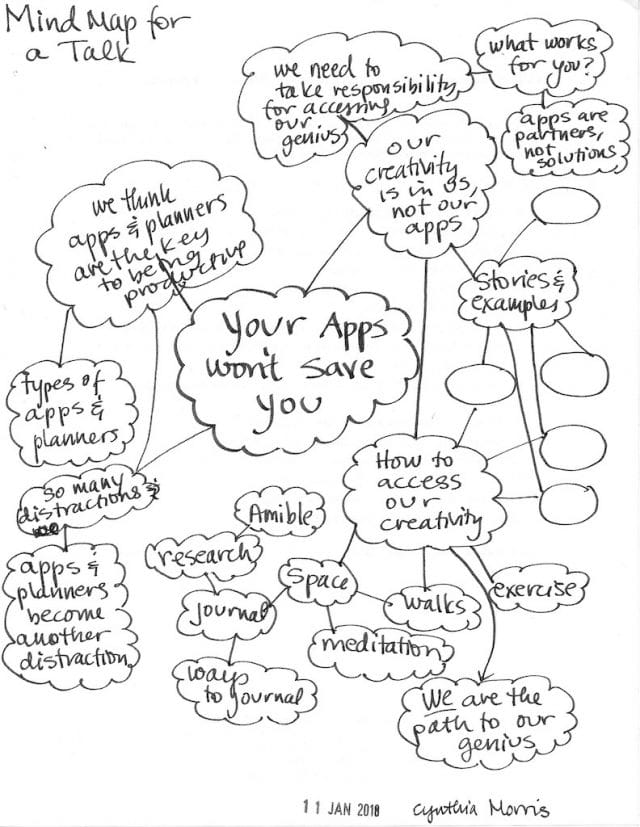
mind map topics speaker Cynthia Morris writing prompts

Here’s a mind map here of a talk I developed. I brainstormed the premise and ideas around this topic. You can see it’s messy, but that’s okay. The content is out of my head and onto paper and I can start writing, using each bubble as a prompt to get started.

Four ways to mind map

Try it for yourself, using mind mapping to generate a list of prompts. Here are a couple ways to experiment with that.

Method one: Simple piece of paper or notebook.

Method two: Gather sticky notes and a blank wall or large piece of paper.

Method three: Use index cards.  You may use several different colors, in order to color code different types of content that are in your book. Red for explication, green for example stories, yellow for exercises.

Method four: Use a digital mind mapping program like Milanote (which allows for exportable PDFS, unlike other programs, Simple Mind or Mindmeister.

Instructions for mind mapping your book’s topic on paper

I don’t use a mind mapping app because it’s just so fun and easy to use an analog process. I prefer the spaciousness that I feel when I am not looking at a screen.

Here’s my go-to method for developing writing prompts for my book using a paper mind map. 

Get a piece of paper. You can get a large one or just a piece of printing paper. In the center of a page, put the basic premise of your book in large letters. It’s helpful if you have a working title, but don’t fret if you don’t. If you are using sticky notes or cards, simply lay them out as you write ideas on each piece.

Now, brainstorm different things you want to say. There may be several large categories, each having its own bubble that comes off the central bubble.

For each category, capture the ideas you have for that category. Each idea has its own bubble, sticky note or index card. Don’t worry too much about organizing your ideas now; just get as many of them out as you can.

You can see from my mind map that the content isn’t completely organized. That’s okay. The organizing will come later, after I’ve drafted most of the pieces.

From here, I often move each item to an index card. This creates a deck of writing prompts that I can use to write from. The index card/sticky note process allows you to move your ideas around if you find they belong with a different category than you originally thought.

Keep playing with this until you are out of ideas. Go take a break and come back to see it anew. The mind map can be a living document that grows over time.

Inquiries for greater understanding:

  • What do you notice about your content?
  • Which categories have the most ideas?
  • Which ideas or categories feel most compelling to you?

Let this settle for a week or so, adding to it and moving things around until you feel you have most of your ideas on paper and where you want them to be.

Use mind mapping to get your ideas on one topic onto the page. This is a fun and non-linear way to gather your thoughts.

Final thoughts on mind mapping your book ideas

Write from each prompt until you’ve exhausted your ideas. This may take several writing sessions before you feel complete with the prompt. 

Remember that writing from these prompts is simply drafting or capturing your ideas. The writing will be rough, messy, and unorganized. It will feel incomplete and perhaps incoherent. Don’t fret! This writing will also be raw, real and fresh. It will have your voice and your conviction on it. It will be material that you will revise, edit and sculpt into something you can share with the world. But don’t get ahead of yourself with word smithing and perfectionism, either in developing your prompts or free-writing from them. 

Writing prompts can be simple. Don’t overthink them. The best part of free-writing is the surprises that emerge when you step aside and let your pen lead the way. Writing prompts can help you dive in and swim past the inner critic to write anything, anytime. 

To recap:

  1. Map your ideas on paper.
  2. Take the most juicy ideas and put them into a list or on index cards to use as prompts.
  3. Mind map each idea until you know what you want to say.
  4. Use each idea or bubble as a free-write prompt to get your thoughts onto the page.

What will you mind map now?
Filed Under: Creativity, The Writing Life Tagged With: mindmap

June 9, 2020 by Cynthia Morris 1 Comment

Writing as a power tool to end systemic racism

The protests of the horrible death of George Floyd and other black people in the US have finally brought our systemic racism to the surface in a way no one can ignore. I feel my own complacency has reached its expiration date.

It’s hard to see violence ripple through the world like this. And I know that massive change is often required to make the changes we need. Inertia, as you may well know, is a powerful force.

There is a feeling of hope that this time, finally, we are awake to the fact that the world needs to change. Is changing. If our constitution promises liberty and justice for all, that has to be more than lip service. This is going to take some work and each of us plays a part.

I don’t have answers for what you should do to end racism now. I know what I am doing. I’m taking a tip from my friend Jonathan Fields. He suggested that the anti-racism work we need to do is a practice. It’s not a donate once and done kind of situation. It’s ongoing work on ourselves and work in the world.

How? Let’s figure it out. Don’t ever let not knowing how to do something keep you from doing something.

Writing as a power tool

As your writing coach, I encourage you to use writing in every instance. Writing clarifies. Writing heals. Writing shows us a path forward.

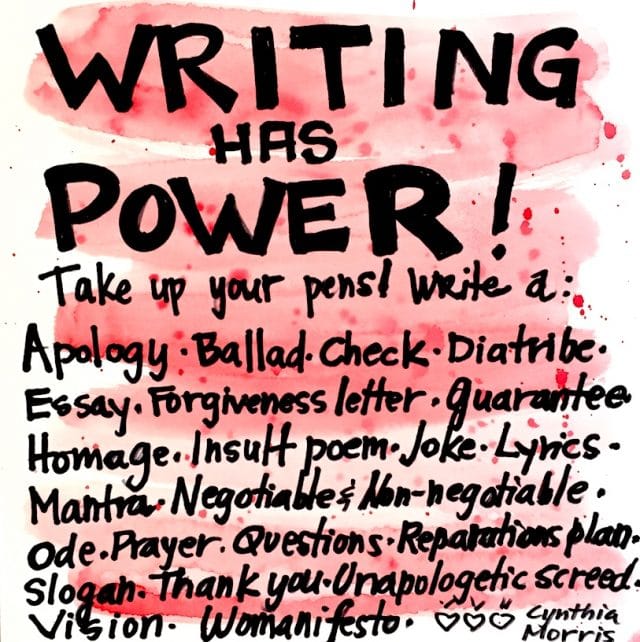
There are as many ways to use our words in this fight as there are words. Write a letter. Write a truth. Write an article. Write a confession. Write an apology. Write a commitment. Write a manifesto for a new world. Write a rant. Write a love letter.

writing has power to help be antiracist
Perhaps start with a free-write to get grounded and to get clear. Here are some bonus prompts I shared in The Devoted Writer salon this week:

  • Becoming an activist
  • How I lead
  • How I follow
  • My racism
  • Change and me
  • My addictions
  • Here’s what I want for the world
  • What I need now
  • My commitment to change

In my classes, we have talked many times about our emotions and how they impact our ability to write. I know many of us are having a hard time focusing on anything now. Hard to stop reeling and feeling and settle into any writing. That’s okay. Do what it takes to take care of yourselves. Do what you need for your writing. And do what we all need to make our world whole – do something to end racism.

I stand for peace and justice for all. I stand with Black Lives Matter and I commit to doing my part to end systemic racism in the US.

Do what is right for you, and if you feel like sharing the actions you are taking now, please do so in a comment below. I know that would inspire me and help me take more action.

Filed Under: The Writing Life

May 10, 2020 by Cynthia Morris Leave a Comment

Pop Up Writing Salon: Flash Fiction

Join us Friday, May 15th at 1:00 pm EDT for the no-cost Pop-Up Writing Salon. Our topic is Flash Fiction.

We gather for an hour or so, and spend most of our time writing together. We do not share our writing nor do we process our writing.

This week’s topic is FLASH FICTION. I have some great prompts for us to spark our innate creativity. We need it now! It’s this Friday May 15th at 1 pm EDT. Double check your time zone!!

Sign up here. If you have already signed up for the Pop-Up Writing Salon, no need to do so again. See you Friday!

Filed Under: The Writing Life

April 28, 2020 by Cynthia Morris Leave a Comment

Your writing practice could help your sanity now

You probably know that writing has sustained my sanity and creativity for a long time now. And, it’s my mission to help people craft a writing practice that honors them and serves their writing dreams and goals.

I was poking around online recently to see what people were saying about a journaling practice. I found an article on the New York Times:

What’s All This About Journaling: One of the more effective acts of self-care is also, happily, one of the cheapest  by Hayley Phelan

The following two paragraphs blew me away. I know the benefits of regular writing firsthand, and I have seen hundreds of people’s lives change as a result of the practice. But I’d never thought of writing this way:

“….writing is fundamentally an organizational system. Keeping a journal, according to Dr. Pennebaker, helps to organize an event in our mind, and make sense of trauma. When we do that, our working memory improves, since our brains are freed from the enormously taxing job of processing that experience, and we sleep better.

This in turn improves our immune system and our moods; we go to work feeling refreshed, perform better and socialize more. “There’s no single magic moment,” Dr. Pennebaker said. “But we know it works…”

(Emphasis mine; James W. Pennebaker is a social psychologist at the University of Texas at Austin who is considered the pioneer of writing therapy.)

The cool thing about a journaling or writing practice is that it can do so many things. We can write to refresh and release. We can write our way to clarity. We can write from our imaginations and for our work.

If you haven’t been writing, I invite you to pick it up today. Don’t do it ‘right’. Don’t do it my way. Do it your way and let your pen lead you closer to yourself and what you want for your life.

There’s still room for you in our online writing salon, The Devoted Writer. We’ve only just begun and already people are savoring the positive effects. Like Patricia Mauerhofer, who shared in our salon:

“I am soooo grateful and happy for being here and having signed up…7 days and my playful creativity juices are starting to flow again.I also became aware why writing just a little every day is good enough for now.”

Writing every day isn’t the goal; being connected to ourselves through a writing practice is our focus. Some people are working on projects, others are writing just for themselves.

Join us here.

Do you have a writing practice that honors you? Share in a comment below one thing that helps you connect to your writing practice. 

Filed Under: The Writing Life

April 13, 2020 by Cynthia Morris Leave a Comment

Pop-Up Writing Salon: Pleasure

Join us Thursday April 16 for the no-cost Pop-Up Writing Salon.

We gather for an hour or so, and spend most of our time writing together. We do not share our writing nor do we process our writing.

This week’s topic is creativity. I have some great prompts for us to spark our innate creativity. We need it now! It’s this Thursday at 1 pm PDT, 2:00 pm MDT, 3:00 CET, and 4:00 EDT. Double check your time zone!!

Sign up here. If you have already signed up for the Pop-Up Writing Salon, no need to do so again. See you Thursday!

Filed Under: The Writing Life

March 25, 2020 by Cynthia Morris Leave a Comment

Pop-Up Writing Salon: Creativity

Join us Friday March 27th for the no-cost Pop-Up Writing Salon.

We gather for an hour or so, and spend most of our time writing together. We do not share our writing nor do we process our writing.

This week’s topic is creativity. I have some great prompts for us to spark our innate creativity. We need it now!It’s this Friday at 10 am PDT, 11:00 am MDT, 12: CET, and 1:00 EDT. Double check your time zone!!

Sign up here. If you have already signed up for the Pop-Up Writing Salon, no need to do so again. See you Friday!

Filed Under: Creativity, The Writing Life

March 17, 2020 by Cynthia Morris 4 Comments

Design Your At-Home Writing Retreat

Stuck at home? Your writing can be a haven in this time. Yet it can also be hard to drop in and find focus.
I made a tutorial with suggestions for designing an at-home writing retreat. It could be short, it could be all day. However long your retreat is, make it work for you.

Filed Under: The Writing Life

March 13, 2020 by Cynthia Morris Leave a Comment

Stop the self-censorship!

Usually, the first person in the way of letting ourselves create what we want is US! This self-censorship is painful and unhealthy. I offer a few ways to stop this so you can write and make what you want.

Filed Under: Creativity, The Writing Life

March 11, 2020 by Cynthia Morris 1 Comment

Writers and artists – your emotions are your greatest creative asset

It’s quite the emotional roller coaster these days, isn’t it? I feel and notice a lot of fear. And uncertainty, which fuels fear. There’s a lot of anger, and also wafts of hope.

We are living in tough times for sure. We need to seek groundedness. If we don’t replenish ourselves and keep our immune and nervous systems in balance, we put ourselves at more risk. Taking care of ourselves is a priority, even when we are caring for others.

But what to do with all those feelings? This is where our art and writing can save us. All good art is based in true emotions. You’ve heard this before: someone can be technically proficient at their art. But if there’s no feeling behind the words, the sketches or the performance, what’s shared is simply polished gestures.

We are attracted to art and writing that moves us emotionally. The artist or writer has put something of their essence into a piece.

Tune into your emotions to improve your writing

Now, when the emotional temperature is running high with all kinds of feelings, we can observe our inner landscape. This is a great time to practice writing from our feelings. 

It’s challenging to describe emotions. I have learned that we don’t feel our emotions first as thoughts, but in our body. Look to your body to give clues about how to describe your feelings. Where does that anger express itself? A tight jaw? A quickened step? Clutching the steering wheel as you drive?

What about fear? Where does that take space in your body? How would you describe that?

Developing this kind of awareness of our emotions and how they live in our bodies is good for our writing. It’s also good for our emotional health. Emotions are a fascinating thing. They are always running in the background. But we often don’t have a clue what we are feeling. I am working daily on emotional intelligence. It’s not easy, but my writing is an ally in this journey to be fully human.

Getting more present with our emotions helps us both as humans and as creative people who want to make things we deeply care about.

Take time to practice emotional awareness. Do a quick free-write to explore your emotions right now. Your prompt: I’m feeling…

And consider joining us for the Pop-Up Writing Salon on March 12, 2020, where I will facilitate a writing session focused on the emotion of fear. Save your spot here.

Filed Under: Creativity, The Writing Life

March 9, 2020 by Cynthia Morris Leave a Comment

Pop-Up Writing Salon

I’ve been doing daily writing based on my own prompts, These are coaching inquiries that I often ask my clients. Some of them are ones I wish someone would ask me.

One of the hardest prompts to write from was: “What are you afraid of?” 

It was hard to stay with my fears for a full two pages. And yet, I feel plenty of fear. Our world has tipped even more toward a fear-based experience.

And yet, it’s hard to be with our fears. It’s hard to pinpoint what we are afraid of.

In all my years as a writer and writing coach, I have seen the profound benefits of staying with an inquiry and letting ink lead us to deeper truths. When we are able to explore what’s inside via our pen or keyboard, we get so so so so so much more than when these thoughts and feelings just rumble around inside us.

I am hosting Pop-Up Writing Salons where we give space to ourselves and our ink to write. After a brief welcome and introduction to our writing guidelines, we will dive into a series of writing sessions. Using my prompts, we’ll explore what’s true for us around the topic of fear.

These are not salons to ‘get writing done’ but instead to get in contact with ourselves and what we feel and think. There will be no critiquing or reading of our writing. There will be no sharing of our writing. Instead, you will be invited to reflect on how the writing was for you, shared in a simple and easy way, if you wish. 

I am skilled at hosting a safe, supportive space where our we and our writing finally get the space that they need. We will be using my private Zoom channel, and you may choose to be on video or not. You can also call in via telephone.

Join us this Thursday, March 12th at 2:00 PT, 3:00 MT, 4:00 CT, 5:00 ET, 9:00 am on the 13th in Sydney to explore fear.

This is a free, online event. Be sure to check your time zone. Reserve your seat using the link here. 

Filed Under: The Writing Life

February 26, 2020 by Cynthia Morris 4 Comments

Is your writing good enough? 

I was in the car with a friend recently. She was gushing about an author and what a great writer she is.

While I, too, love great writing and appreciate great authors, in this moment, for some reason, my inner critic closed my heart. I felt jealousy and a sense of less-than.

“I don’t think I’m a great writer,” I confessed. She was shocked. She sees me as an accomplished writer with books and plenty of other writing under my belt.

It’s true that I am prolific. Even my inner critic can’t deny that. But I go dark side and don’t know how good I am. My clients face this, too. Accomplished authors feel this. It seems our communal, number one fear is: Will my writing be good enough?

The problem with good enough

The problem with our concern about whether our writing is ‘good enough’ is that ‘good enough’ isn’t a specific target. How, exactly, will we know when it is ‘good’? When someone else validates it? When someone else agrees to publish it? When we get paid or win an award?

good enough writing coach Cynthia Morris

Most of the writing I’ve done in 25 years hasn’t earned me the big bucks or garnered prestigious awards. But that doesn’t mean it’s not good.

I remember a day when I clarified what ‘good enough’ meant for me. I made the decision to self-publish my Paris novel Chasing Sylvia Beach. I realized I didn’t need someone in the publishing industry to approve and signal that it was a ‘breakout novel’. The power and self-acceptance I claimed felt so good.

I had the same feeling with my last book, The Busy Woman’s Guide to Writing a World-Changing Book. I wasn’t trying for ‘great writing’. I wasn’t aiming to be clever or demonstrate how ‘good’ I am as a writer. I was simply aiming for clarity so my readers would be inspired to take immediate action toward writing their own books.

Same happened with my podcast essays. I hoped to write honest, humorous and authentic essays. I wanted to move my listeners with stories that showed how we all face stumbling blocks in the creative process. At first I read books about how to ‘write funny’. And consumed storytelling books. And listened to others’ podcasts.

For sure, a certain amount of study of our craft is necessary. We can always improve. No matter how talented you are, your free writes will nee editing. Getting constructive feedback and practicing our craft is part of the game.

And, there comes a time when we have to shut off the hose of information and turn to our own deep well and write from there. When you have to trust that your writing is good enough. You have to relinquish control and release it into the world. It will or will not meet your readers in the way you hope.

I am fortunate that I spend a lot of time writing. This gives me a chance to both continue to work my craft and to let go of insecurities about whether the writing is ‘good’. As you see, these insecurities still arise.  But my definition of great writing has changed. It’s less about whether someone else is approving of it. My metric for good writing these days is whether I am being as honest and wholehearted as I can be. 

Over to you

If you live alongside the ‘good enough’ gremlin, I invite you to get clear on what ‘good’ is for you now. Do a free-write to clarify your own metrics for good writing. What does this spark in you? Leave a comment below let us know your relationship to ‘good enough’.

Filed Under: The Writing Life

February 21, 2020 by Cynthia Morris Leave a Comment

Be a better editor of your own work with this book on book writing

As writers, we are often blind to the errors or flabby writing in our projects. The ability to edit our own work is something we develop over time.

The number one mistake writers make is sending their work to editors or agents before it’s as polished as it could be. I get it! We want to finish something and get it out there.

Another challenge my clients face is editing too much. They peck away at something for so long that it loses its voice and vibrancy.

If only we had a checklist to make this easier!

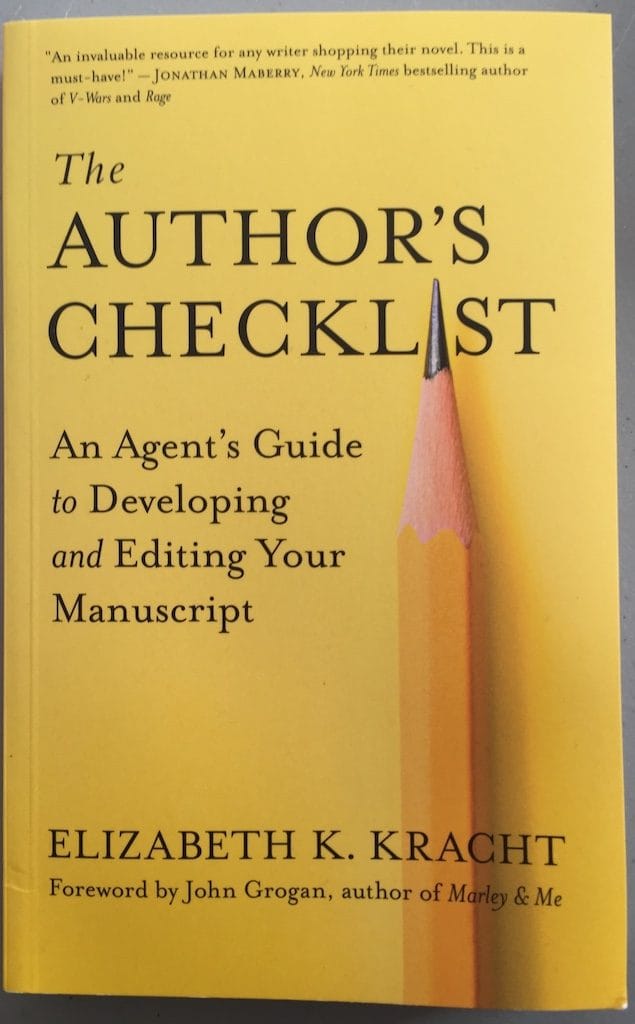
Voila! We do! Literary agent Elizabeth K. Kracht has written the guide to help us all be better writers. The Author’s Checklist: An Agent’s Guide to Developing and Editing Your Manuscript is here to help wannabe authors do their very best with their manuscripts.

There are lots of books about book writing, and this one helps us be better writers not just for the book at hand but for future books. Definitely one of the best books on writing I’ve seen.

Written in the format of A to Z, the chapters are encouraging, specific and helpful. This book will guide writers to make their manuscripts better. And, what we learn for one project can always be applied to other projects. A must-have for those who want to really make their work shine.

Filed Under: Books for Creatives, The Writing Life

February 12, 2020 by Cynthia Morris 2 Comments

Unstuck yourself with love

Do you ever feel ‘stuck’ with your writing? Like you just don’t ‘feel like it’ or doubt your words?

Sometimes when we think about writing, it’s like we’re asking ourselves to deep clean the refrigerator. Or drive two hours in rush hour traffic. Or some other onerous, cringe-worthy task.

What happened to the love?! We somehow forget that we want to do this writing thing.

This stuckness happens to all of us at some point. We face a creative wall and look for ways out. We like to think that external structures are the key to bringing out writing back.

We grasp for solutions like: Set a timer. Schedule it on the calendar. Get an accountability buddy. Take a class. Hire a coach.

And while those things absolutely can help, I suggest something adding something else to your get unstuck toolkit. Something deeper.

Start from the inside.


Bring the love to your writuals!

The next time you find yourself avoiding your writing, remind yourself that you actually want to do this. That you perhaps even enjoy writing. That it’s in your life because you want it to be, not because you are forced to do it.

I offer you one of my favorite writing prompts that has helped my clients recommit to their writing with more ease. This prompt can be used again and again. It can give you profound insights that could indeed banish your writer’s block to a faraway planet. Ready?

What I love about writing…

Set your timer for ten minutes and respond to this prompt. Let your heart lead your pen. See what comes up. Share your insights below.

Want to love writing with us? Join us for a five-week power group, Write ON. We begin soon!

Filed Under: The Writing Life

February 3, 2020 by Cynthia Morris Leave a Comment

Writers’ Coaching Group: What Makes This Different

People often ask me what is a ‘writers’ coaching group’? Many writing workshops are focused on the craft of writing. Accountability focuses on getting stuff done.

From what I have seen in my writing groups, if it were just a matter of scheduling writing time and showing up, it would be easy.

Writing, and other art forms, seem to bring a range of inner obstacles. “Do I really have something to say?” “Will my writing be good enough?” “Is it safe to write my truth?”

These are some of the issues that show up when we show up to do the writing. As a trained coach, I have specific skills to help not just show up and write, but see, explore and work through these issues that stop us. My intention is that the coaching work we do in our groups helps all members overcome the obstacles that have held us back.

You can see that answering those fears with ‘tips and tactics’ are just bandaids for deeper issues. Set a timer! Just do it! Get accountability! These are helpful in the short-term but don’t do enough to help someone become empowered to write anything, anytime.

Working with me either one:one or in a group is a way to finally develop skills to write what you want, when you want. Even when the old fears show up, you will know how to move forward.

Writing coaching group Cynthia MorrisOnce, someone in my group said “What a bunch of whiners!” I was shocked – I don’t see us that way at all. I see the courage and fierce determination to show up ready, willing and able to address whatever is in the way.

So, while we sign up for ‘accountability’, what we really get in this group is a way forward with heart and soul. A way that allows us to respect and honor our creative impulse.

We have a few spots left in this potent writers’ coaching group Write ON, which starts on February 17th. Join us to write what you are meant to.

Claim your writing seat here.

Filed Under: The Writing Life

January 29, 2020 by Cynthia Morris 2 Comments

What if your #1 excuse for not writing wasn’t true?

When it comes to our creative and writing projects that aren’t immediately tied to our financial well-being, aka work, we sometimes struggle to truly commit. We cite lack of time as our #1 excuse for not writing that book or other creative project.

Of course! We are all busy with life and work and family. So it’s easy to believe 100% the idea that we don’t do our writing, creative work and passion project play because we don’t have time.

I assert that the only thing we do have is our time. We all have the same 24 hours to allocate to what matters to us. The choices we make reflect our priorities. And sure, survival and making a living is a priority.

writing coach excuses time management Cynthia Morris

Do you see yourself in this story?

I was recently talking to a friend about his writing projects. He writes a lot for work, and yet I know he harbors a desire to write creative, fictional projects. When I asked about whether those dreams were going to get air time this year, he sighed. Time, he said. I don’t have time.

I get it. He’s a super busy executive and dad. Yet later in our conversation we were talking about bedtime and whatnot, and he revealed that he stays up to midnight most nights. Wow! I said. What’s happening in those hours between ten and midnight? Nothing much, he shrugged. TV binge watching.

Yep, I get that! I, too, have fallen for the way TV shows and streaming services are designed to keep us glued to the tube. And being the coach that I am, I couldn’t help but think, hmmm…if you went to bed even an hour earlier, you could get up earlier and have that extra hour to write your passion projects.

But I didn’t tell him that. It’s not my business to coach friends or people who don’t raise their hand for it. And it’s also not my practice as a coach to tell people what I think would work for them.

My job is to help my clients and students discover the habits and practices that allow them to not defer their dreams until some faraway future date, say, when they retire. It’s my joy to help people use their natural resourcefulness and creativity to make the space they need for the writing projects they yearn to commit to.

What’s really going on?

Is lack of time your excuse? I suspect that we use this handy excuse to avoid what’s really going on. For example, I was coaching someone who was really fired up about their creative pursuits. She was psyched to have a creative project and set up some parameters to make sure she had studio time. But within a few weeks, work got busy and life stuff also played a role in nudging her commitment to herself to the side.

It would be easy to think this is a time management issue, or a true scarcity when it comes to available time.

When we explored this a bit more, we saw that she stopped going to the studio right about the time when she began doubting the point of doing her creative work. It wasn’t going to make her money necessarily. It wasn’t going to make her famous.

Spending time in her studio makes her happy. Enthusiastic. She feels a sense of herself and her own unique vitality when she made art. In these times, I believe we need all the joy we can get. And if we can generate our own sense of well-being and engagement through our creative work, I am all for it. So what if the world doesn’t pay you now – you are paying yourself by showing up for your own dreams.

If you are reading this and feeling a bit called out on your #1 excuse for not writing, well, good. I am not here to maintain the status quo. 

What a trained coach offers to the writing process

My work as a coach is to help you grow as a person. This is the difference between working with a writing coach who is actually a trained coach and not an editor, writer or teacher using the word ‘coach’ to describe their work. Those professionals have the goal to help their clients get their work written. And I do, too. However, I also know that truly transformational coaching that gets the job done isn’t solely about time and project management.

I believe that our creative pursuits offer an excellent path not simply to get things done, but to step more fully into our potential and our joy. 

With that in mind, ask yourself this: If time wasn’t my real reason for not writing, what does hold me back? Be honest and be kind when you give yourself this inquiry. It’s not intended to shame you or make you feel badly about yourself or your commitment. It’s to give you the chance to maybe make choices that reflect what’s true and deep in your world both inside and out.

What’s true for you? Share your thoughts below.

Filed Under: The Writing Life

  • « Go to Previous Page
  • Page 1
  • Page 2
  • Page 3
  • Page 4
  • Page 5
  • Page 6
  • Interim pages omitted …
  • Page 14
  • Go to Next Page »

Primary Sidebar

A great escape read!

Cynthia Morris novel Her Lisbon Colors

Let’s Connect

  • Email
  • Instagram
  • LinkedIn
  • Substack
  • YouTube
Finally be the creator you came here to be
  • This field is for validation purposes and should be left unchanged.

Copyright © 2026 Original Impulse. All Rights Reserved. Privacy Policies.