• Skip to main content
  • Skip to primary sidebar

Original Impulse HomepageOriginal Impulse

  • Work with me
    • Quantum Energy Clearing
    • Write ON
    • Writer’s Coaching
    • Paris Sketchbook
  • About
    • About Cynthia
    • Successful Clients
    • Media
    • Speaking
  • Books
    • The Busy Woman’s Guide to Writing a Book
    • Her Lisbon Colors
    • Client Books
    • Books for Creatives
    • Book Recommendations
  • Contact

Cynthia Morris

September 29, 2020 by Cynthia Morris 11 Comments

Non-Violent Entertainment

Sometimes I pretend I am an alien, arriving on this planet.  Frankly, I feel like an alien a lot of the time because I just don’t understand humans.

Something that twists my head around is violence as entertainment. Here’s what I see:

We are horrified when there is a mass shooting or other cruel behavior. Yet, our entertainment choices are flooded with the same violence. If I were an alien, I would see the images of violence on the news and the violence in movies, TV shows, and video games, and I would not differentiate between the two.

Clearly, for some reason, we get our jollies on violence. But then we’re surprised when we see the same thing play out in real life.

My inability to consume violence for fun came to a head for me shortly after the pandemic hit the US. Steve and I had been vegging out watching TV. My favorites were Babylon Berlin, Outlander, Barry, and Ozark. Killing, killing, killing. And worse.

After a particularly violent episode of Outlander, I noticed how fearful I was. Going to sleep afraid. Waking up afraid. Fear infused me as a result of all the tortuous images I had been consuming for relaxation.

It wasn’t until I was watching The Kitchen, about three women who take over their crime boss husbands’ jobs, that I couldn’t bear one more scene of a person killing another in cold blood. There was nothing fun, enlightening, entertaining, or illuminating about seeing someone gunned down in a cavalier way. 

At the end of May, I committed to not consuming abusive situations for entertainment. June had plenty of real-world violence; who needed more for fun?

This dovetailed with my long-held practice of consuming media and books from women, focused on women. I believe we need to see women in positions of power, using their strength, to shift a world with more women leading. 

I use the Bechdel Test to determine if something is worth watching. From Wikipedia: The Bechdel Test is a measure of the representation of women in fiction. It asks whether a work features at least two women who talk to each other about something other than a man. 

Luckily, it’s getting easier to find media that pass the Bechdel Test. I love psychological dramas. That would be French and Swedish films, as well as indie films. Steve prefers what he calls L&F – Light and Fluffy films. Romcoms!

All of this matters to me, not just as a person who consumes media but as a creator. I stand for those who are writing new stories, stories that inspire a new vision of the world. Stories that feature BIPOC and women. Not just light and fluffy but real and inspiring.

Here are two movies I’ve watched recently featuring strong female characters. I’m not going into any analysis of these movies, and I am sure there is plenty to criticize in these shows. I don’t expect that they depict reality, but they feature brave and bold women despite the odds.

The Sapphires is about a group of young Australian singers who leave home to entertain troops in Vietnam.

All Together Now features a young woman who struggles to get beyond her circumstances to make a better life for herself—also starring Carol Burnett as an elderly curmudgeon.

How about you? Are you consuming less violence for fun?


Filed Under: Books for Creatives

September 3, 2020 by Cynthia Morris 1 Comment

Happy 20th birthday, OriginalImpulse.com!

I received a notice recently from my web host. In the email, I saw that I had registered the domain on September 3rd, 2000. A twenty-year-old web site, imagine that!

With the help of the Way Back Machine, I was able to go back in time and gather images of my website through the years.

What’s cool is that while the look of the site has changed, the message of my work has stayed consistent. For over twenty years, I have been an advocate for our creativity as a necessity for our well-being. I’ve used my coaching skills and experience as a writer and artist to walk alongside thousands of creative people who have been ready, willing, and able to say YES to their creative dreams.

My website and newsletter have evolved over the years, and so have I. I’m happy to say that while the style of the sites may be outdated, I’m still proud of the design of each of these iterations. While design trends have come and gone, my commitment to writing and creativity as sources of personal growth and empowerment has always stayed steady.

Here are six versions of OriginalImpulse.com. Of course, the seventh version is the one you see now.

Cynthia Morris coach
The very first site, based on a photogravure by Brassai.
Cynthia Morris writer's coach
Version two, with some fun visual elements and my manifesto!
Cynthia Morris book coach
Third version, with way too much text on the home page!
Cynthia Morris creativity coach
Version four, with a fun header, not all elements are shown here
Cynthia Morris coach
Version five with a serious header


Cynthia Morris author artist
Version six


Filed Under: Creativity

September 2, 2020 by Cynthia Morris 10 Comments

A notebook makes space for your creative projects – but we need more than that

You may know that I am a notebook geek. I use notebooks* to gather ideas, process feelings, make plans, and stay on track with my projects. I’ve tried digital systems for these things. But I already spend plenty of time looking at a screen, and I prefer to dream and plan offscreen.

Right now, I have six notebooks going:

  • Sketchbook
  • Garden sketchbook
  • Garden progress log
  • Business notebook
  • Personal journal
  • Art project notebook

This last one is important. You know how you only notice the value of something when it’s gone? I usually have a notebook for my art projects. Inside are ideas, plans, notes from meetings, to-do lists, and other jottings related to the process of making things.

Cynthia Morris notebook journal creativity writing art coaching
My current stack of notebook allies with flowers from my garden

But this summer, I wasn’t using a notebook for that. For some reason, I thought I could just roll my art planning into my personal journal. And guess what happened? Not much in my art projects. Once I finished the 100 Day Project, my focus on my art waned. It wasn’t until I got a notebook off my shelf, made a pretty cover with decorative paper, that my zest for art projects came back. This reminded me that what we focus on thrives.

Recently, I dove into the art journal for a brainstorming session. What had begun to feel like a dry field – no ideas, no enthusiasm – became fertile ground, rich with possibilities and plans. I returned a direction for my art that has been in my mind and notes for over three years. My artist, and what she wants for the world, is back.

All this joy came because I dedicated a specific space for her and her ideas. A simple notebook provides the container for my artist.

While this part of me is vital, my art can still get pushed aside. It’s easier to focus on work, where I am rewarded more quickly and visibly. I see the impact my coaching has on my clients. My bank account gets the reward of being paid for my work. I feel a kinship with my colleagues, who are also working hard. We get a lot of external validation from being a hard worker and getting things done. 

My artist might not make me money now or ever. But making art feels good to me. It fills in the picture of me, giving me a sense of integrity and wholeness that we all seek. And yet, to the outer world, it might look like I am sitting in the garden painting pretty flowers. Frivolous. Not contributing. Not making a difference.

I believe that when we feel whole, when we feel our full vitality, we do contribute. We don’t waste time feeling envious because we are aligned. There is no part of us that’s banished or ignored. When we give attention to the things we love, we signal to ourselves and those around us that we matter.

Make space for yourself and what matters

Space isn’t just a physical spot like a studio or corner of the desk. Space for yourself and your dreams can look like:

  • A dedicated notebook for your ideas and dreams.
  • Time marked off – and kept – on your calendar.
  • Regular meetings with an accountability partner – a peer, a coach, a group.
  • A program or class that allows you to focus, learn, and grow.

This last one – signing up for something to force our focus on our passion projects – is pretty common. It’s not always the wrong way to make sure you get the space you need. Signing up for a class or program is a bad idea when you think that signing up means you’ve done the work. Sometimes we sign up and then go AWOL. We don’t show up. We don’t realize that there’s more to creating space than just getting the notebook, or the supplies, or registering for the class.

When we commit to space for our projects, we commit to ourselves. To facing the fears and insecurities that are our actual reasons for not showing up. To confronting the skills gap that has kept us on the sidelines. To reckoning with where we are and what we genuinely need to do our creative work.

It’s not the gear or the class. It’s self-respect that’s required to take a stand for ourselves and our ideas. To say, you know what, I don’t have any idea where this book or body of work or business idea is going, but my ideas and creativity are worth exploring.

What are you doing to make space for your passion project? 

We have a few spots left in the Original Impulse Atelier. This is a creative haven designed to give you the space and focus you crave for that project that must be made. Find out more here.

*I am considering doing a series to share in-depth how I use various notebooks to keep me on track personally, professionally, and creatively. If this is of interest to you, please let me know in a comment below.

Notebooks shown in this article include**:

Hahnemühle watercolor sketchbook

Go To Notebook by Chronicle with Mohawk dotted paper, Sage Blue

Moleskine Classic Dotted notebook, XL, reef blue

Moleskine Cahier, soft cover

**Affiliate links are used in this article. I only recommend products I use and believe in. I may receive a percentage of the sale price if you buy from one of these links.

Filed Under: Creativity

August 26, 2020 by Cynthia Morris Leave a Comment

Be a better writer with an apprenticeship approach

You may have heard me talk about my own writing path, but in case you haven’t, I’ll share some things that might help you on your writing adventures. My hope is that this post will help you to identify the things you want to write about in case you feel stumped.

I began writing in earnest in February, 1994, in a class called Writing the Wild Woman. I had no idea what to write, just that I wanted to write.

This is where I learned the joys and power of free-writing. I joined other free-writing groups and relished the fun of letting my words flow freely.

Somewhere in that first year, I got the notion to write for five years without worrying about it being any good or being published. Five years!

During this time of apprenticeship, I explored various genres. I took classes in playwriting, screenwriting, story writing. I wrote poems, essays and recipes. I filled journals with my desires, my rants and my voice.

Finally, after five years of this, I had a greater sense of what I wanted to focus on. I wrote articles for the local paper. I began writing a novel based on a heroine of mine, Sylvia Beach.

Also in 1999, I became a trained coach and began writing newsletter articles, marketing copy and e-books about the writing process. I’ve since written hundred of articles, seven e-books and a novel. I am still writing, using this free-writing method.

Give yourself time and space to write. Be an apprentice, learning about yourself and about the craft of writing. Be patient. Keep showing up. Devote yourself to your writing.

How does the idea of being an apprentice appeal or not to you?

Filed Under: The Writing Life Tagged With: apprenticeship, writing

August 24, 2020 by Cynthia Morris Leave a Comment

Writing a Book? Identify Your Reader Right Away

If you have a business, you have no doubt spent time identifying your ideal client or customer. This is known as your “avatar.” When you know what motivates them and understand the problem your product or service solves, it’s easier to design things that you know they will need, buy, love, and rave about.

Perhaps your avatar is simply another version of you. Many people have built wildly successful businesses making things that they themselves need and want. If your ideal customer is another version of you, you are in luck. You know your needs and desires—and your challenges—very well. Even if you don’t have a business, you still want to know who you are writing for.

When writing a nonfiction book, you must have clarity about your ideal reader. What title would make them pick it up? What words on the back of the book make it a must-buy right now? And what would make them tell their friends about it too? It’s important to know these things, not just from a marketing perspective but from a writing perspective. Often when we sit down to write, we become overly formal and lose touch with our voice and our confidence.

When we have a clear sense of who the ideal reader is, it’s easier to write directly to them. Write in a conversational tone as if you are having coffee together and you are telling them everything you want them to know about your topic. Ideally, this is a real person you know. Having a real, specific person in mind will make all the difference. Your writing will flow and decisions will feel easy to make. And yet, you will resist it. You will want the book to be for everybody. You will think of three or more separate audiences for whom your book would be of interest.

That’s the problem—it’s not for an “audience.” When you think of that word, what comes to mind is probably a bunch of people or a big group. But when you think of one specific person and the problem this book is solving, you will make writing your book infinitely easier. Trust me. I understand that you can see your book’s value for different kinds of people. You want to be inclusive, but for your book’s focus, I want you to be exclusive. Your book is not for everyone. You aren’t pleasing everyone.

Let’s use a target model to drive this concept home. Suppose you are writing a book about how women can fit exercise into their life. Now identify up to three kinds of readers for your book. You want it for busy moms because you are a busy mom and you know that your methods work for you and your friends. You also want more people to have this information. Everybody needs this! But for now, choose just three potential readers. These three types of readers could be busy moms, college students, and business owners.

If you try to write to all three kinds of readers, your writing will go all over the place. Imagine a target. Put your main reader in the center ring. Your next type of reader goes in the second ring, and so on. When you write to hit the heart of the target, you meet your main reader and their needs. Anyone else picking up the book could also find value. With your main reader in mind, you will not be without direction.

I cannot emphasize how important it is to have this very specific person in mind when you are writing.

Exercise

Take some time to free-write about your ideal reader, the one who needs your book and will recognize it when they see it. Give them a name and get very clear about who they are and why your book is important to them. Write a letter to your reader about how your book will help them live a better life.

Tell them that you are excited to share this information and why you are the perfect person to do so. Now print that up and keep it in your writing zone so you are always writing to them. Include a picture of them if you can. Later, some of what you have written could be useful in your marketing copy. Next, we will look at the issues your book solves for your reader.

Inquiry

What resistance, if any, comes up for you when I ask you to choose a specific reader?

This is excerpted from The Busy Woman’s Guide to Writing a World-Changing Book.

Filed Under: The Busy Woman’s Guide to Writing a World-Changing Book, The Writing Life

August 13, 2020 by Cynthia Morris Leave a Comment

In conversation with Mark McGuinness on how to write a book

It’s always fun to talk with Mark McGuinness, a creativity and productivity coach in the UK. And it was a true honor to be a guest on his podcast, The 21st Century Creative.

Check out our conversation on writing and book writing. 

Cynthia Morris Mark McGuinness podcast writing book


Filed Under: Creativity

August 12, 2020 by Cynthia Morris 4 Comments

Making Better, More Aligned Decisions

Making decisions is often like a sweaty wrestling match with no clear winner. We grapple with what we want alongside our insecurities. We question our capacity and our abilities. We poll everyone we know to get a quick answer.

I’m in this position as I look forward to my art-making. I feel ready to go to the next level, even if I don’t know what it looks like. A colleague of mine has a group that seems to be a good fit to further me and my art. But I wonder…is this right for me now?

I know I need structure, insight from others, and support to move forward with my art. But am I ready? Do I have enough to go on? And am I willing to plunk down hard-earned cash for a passion project? I have no idea what results I could expect from my art, and I hesitate to commit to something that may go nowhere.

And if I am honest, underneath these practical considerations lurk my insecurities. Is my art any good anyway? What’s the point of it?

With these questions swirling in my head, I knew what was needed—a session with my trusty notebook and my decision-making process. While camping last weekend, I settled under the shade with my pens, notebooks, and a cold iced tea.

I use a series of questions, or inquiries, and free-write my answers. Seeing it all in ink on the page helps me to sort through the confusion. It’s easier to see clearly and access my intuition when I get it out of my mind.

First, I establish the issue at hand: Should I sign up for this program this year? 

Seductive as it is to get absorbed in the details of the possible program, I start with my current commitment. Getting rooted in what I am hoping to achieve helps me start from inside first. I ask:

What do I want for my art this year? What is my focus? 

The next step is one that many people struggle with. Somehow, it’s hard to know what we need. But this step alone can make all the difference in making a good choice for support. Knowing what I want for my art, now it’s time to assess what I need. I ask:

What do I need to achieve my goal? What skills do I need to learn? 

Then, I look to see if the program’s offer meets my needs. I ask:

How, specifically, will this program help me meet those needs? 

Then, it’s time to assess my current obligations and my real ability to have space for this. Taking on too much is a common tendency. It’s partly because we are typically not great at estimating how long things take. I also believe that piling a lot on our plate gives us an easy out for actually doing the work. I want to be sure that I can give this my attention. I ask:

What will need to shift to make room for this program? 

I looked at my upcoming obligations. I identified when and how I would make space not just for the coaching program but for the art-making itself. I feel confident I can commit the energy to make this a worthwhile pursuit.

Lastly, because this is a significant investment, I ask the all-important:

How will I pay for this?

I am currently focused on savings and on building my retirement funds. I assess every expense and refuse to sacrifice my savings goals for new things. Often, when I take the leap and commit to something, the money appears in the exact amount, which is both eerie and wonderful.

I’m not afraid to invest a significant sum in my development. A quick tally of the major programs I’ve invested in over 20 years shows I’ve spent upwards of $50,000. My personal, professional and creative development has absolutely benefited from these investments. And my clients also benefit from what I learn.

Once I worked through this process, a wave of insight and ideas flowed through. I filled pages and pages of notes about what I want to make, what values I honor when I make art, and how I will make space for my art. I have a sense about what to do going forward. I feel both clarity and a renewed enthusiasm for my art.

Ultimately, our choices have to feel right. If we go through a process like this and it still feels ‘off’, trust that. I hope sharing my process helps you make decisions that honor you and what you want for yourself. .

I believe that the answers to our questions are not out there. The answers are inside, and a short session with our wisdom and our ink can help us write our way forward.

What process do you use to make decisions? Share in a comment below.

Filed Under: Creativity

August 4, 2020 by Cynthia Morris Leave a Comment

Women, Words, Wisdom Podcast

Robin Salcido has a great podcast for women over the age of 50. She’s on a mission to rewrite the story that women’s lives aren’t interesting or valuable after a certain age.

I was honored to be a guest on her podcast. Check out the episode here and find out how I met and eventually married my husband at age 50.

Filed Under: Creativity

June 23, 2020 by Cynthia Morris 14 Comments

How we avoid one thing is how we avoid everything

You’ve heard the expression, “How you do one thing is how you do everything.” I think that it could also be true that how you avoid one thing is how you avoid everything.

The American Way of systemic racism and economic injustice have been exposed in ways I can no longer turn away from. I’ve committed to educating myself and taking action. Discomfort, excuses, and obstacles have popped up alongside my commitment. Are you feeling that too?

I’ve been coaching writers, artists, and entrepreneurs for two decades. I’ve heard all our excuses for not doing our creative work. Recently, I noticed that what we experience when we embark on our creative pursuits is the same as what happens when we step up to dismantle racial injustice. 

I have observed parallels in creative work and racial justice work in myself and others. Here are a few things I am finding.

Helplessness and overwhelm

With our creative projects, it’s common that we don’t know where to start. We had so many exciting ideas, but when we commit to our creativity, a fog descends. Too many options paralyze us, and we go limp with indecision. Our abundant ideas turn against us. We decide it’s easier to keep the status quo than to take action.

I’ve heard the same thing when we’re confronted with antiracism work. We know something needs to be done. We exclaim, “But what can I do?”

Not knowing what to do is no longer a valid excuse. Aunty Google always has answers for us. There are countless lists of resources we can access. In case you are at a loss for what to do about racial injustice, here’s an extensive list of antiracism resources. Download and save a copy for easy access.

I know the list of resources is long and may send you into overwhelm. Take an intuitive approach and make a mark next to the things that resonate with you. Make a shortlist of actions you can take now that feel aligned with what you care about.

Blaming and othering

When things get uncomfortable, we often get defensive. We then deflect responsibility. This approach externalizes the problem and lets us off the hook for taking ownership. It can look like this:

With our creativity, it’s easy to blame our circumstances or the people around us for our inability to make space for creative work. My kids, my spouse, and my job take up too much of my bandwidth to make room for writing. Or, I had an insensitive teacher who made an unkind comment about my writing decades ago that has frozen my creative dreams in a time warp. It’s their fault I can’t do my writing. Yes, these things happen. What we do about it is our responsibility.

For the antiracism work, we struggle to accept our part in it. We might say: It’s not my fault I was raised in a racist country. I can’t help that I grew up in a community with little diversity. No one taught me how to think or do differently. I blame my past circumstances for my current inaction.

Blaming and avoiding responsibility is not benign. Making someone else responsible for our circumstances is disempowering to everyone. Positioning people as ‘other’ and asserting that it’s their fault we don’t have the life we want is a fascist tactic that has caused incalculable harm.

Let’s ask ourselves: what is the cost of deflecting our creative or racial justice work? What’s the cost of pretending that it’s someone else’s fault or problem and not our own?

Emotions

Emotions are important. We need them to signal what is right and not right in our world. Yet we often let feelings stop us from taking action. I know I have. Here’s an example.

For the first 35 years of my life, I was financially illiterate. I had no idea how to be financially healthy. I was stuck in the notion that no one had taught me how to manage money. Other than the ‘save more than you spend’ advice from my parents, I didn’t have a clue how to thrive financially.

The systemic lack of basic financial education seemed designed to keep people impoverished and overworked so we don’t have the bandwidth to thrive and help others succeed. This pissed me off big time. I spent my young adult years infused with righteous anger about it. I was financially out of control, spending more than I made and racking up thousands of dollars in debt. I didn’t do anything until I sat myself down and said, so what you are mad. That’s not helping. Just get started.

I read books. I rallied a group of friends to gather monthly to discuss money. Over time, I made enormous changes. The emotions were still there, all along the way. But I learned how not to let them stop me. Educating myself and having regular conversations about finances allowed me to overcome my ignorance and my helplessness. Once I made these changes, I realized I could claim power in other areas of my life. I didn’t have to let emotions stop me.

We rarely avoid our creative work because of external obstacles. What’s under the surface in our emotional life is usually running the show. The conversations I have with my clients are 60% emotional labor, 40% practical.

If we don’t address the stuff churning under the surface, changes don’t stick. This looks like someone saying they want to write, committing to writing, giving it a few weeks, and then bailing out, usually with some of the excuses mentioned above.

Same for the racial justice work. I can sign endless petitions, donate money, and make posts on social media. But until I look at my privilege and how I have benefited from others’ disempowerment, real change isn’t going to happen.

Looking good and seeking approval

The primary fear I help people overcome with their writing is that they are not good enough. We fear that people will read our writing and will see not our greatness but our flaws. It’s easier to hold a writing dream aloft in a future, faraway state than to risk the messiness of our inadequacies.

For racial justice work, we desperately don’t want to get it wrong. We are afraid of saying the wrong thing and being shamed and shunned. That’s a real risk. But for those of us who have been privileged enough to opt out of this work, I invite an empathetic approach. Imagine you haven’t had the option. Imagine the risks a person of color or LGBTQI person is forced to take every single day.

The need for others’ approval is partly a primal safety measure. I get it. But it kiboshes creativity and leadership. Our desire for others to see us in a certain way wastes our energy and time. We can’t control how others see us; we control our actions.

But it’s so hard!

A lot of people want to be writers. Many of us want to be better people. The truth is, what’s required to write and be a contributing member of a better world often pushes us out of our ‘comfort zone’. We’re appalled at how much effort and time goes into writing something. (Six hours to write, revise, and publish this piece.) Or how many layers of crap we have to shovel through to play a role in making room for everyone at the table.

What’s helped me is to not focus on how hard it is. Instead, I focus on the sense of integrity and fulfillment that I experience when I do what I know is right for me and the world. When I show up to be responsible for honoring the gifts I’ve been given and the privilege that I was born into. As I mentioned in my financial empowerment story, when I stopped letting the emotions stop me from taking action, I claimed my power.

I am in the business of personal transformation. Yes, Original Impulse exists to help people write, make art, and grow businesses. For me, those activities serve as vehicles for transformation. The effort required to do all of those things is the work of changing ourselves and the world.

Both our creative work and the work of dismantling our inherent racism may have seemed optional until now. For my part, I am learning and unlearning. I am making space for racial justice work the way I’ve made space for my creative work.

What’s helped me again and again to transform is

1) reading to learn

2) listening to podcasts to get new perspectives

3) writing it out to understand what’s under the surface and

4) consistently having conversations.

What about you?

Get clear on why you must do your creative work now. Understand why you must do racial justice work now. Use these prompts:

I must write because…

I must play a part in racial justice because…

Ask yourself what values you are honoring when you meet the challenges of creative and racial justice work.

I have always been about empowering women and helping people express themselves, so that’s the first place I look. What can I do to contribute to women of color? What are the resources that teach me more about their experiences so I can offer something that’s genuine service and not my idea of what’s needed?

As a coach, I don’t tell people what to do. Instead, I help people find what’s right for them. Sometimes people ask me if they are copping out of doing their creative work. I can’t answer that. Only we know if we are shirking responsibility or copping out.

We have to show up in ways that allow us to live with ourselves every day. That’s why I’ve been able to do the creative work I’ve done – so I can live in integrity. And that’s why I am finally stepping up to take consistent action on my belief that we all deserve a world of equality and opportunity. I’m doing my part to live that value and not just hope others are doing the work.

What resonates with you? Is it true for you that how you avoid one thing is how you avoid everything?

Filed Under: Creativity

June 10, 2020 by Cynthia Morris Leave a Comment

Use mindmaps to brainstorm your book’s topics for writing prompts

Perhaps you are working on a book or other big project. You want to get all your ideas out of your head so you can work with the material. Managing the contents of our books can be a real challenge. There’s so much to say, and we often wonder if we’re adding too much, zinging off on a tangent or making any sense at all.

Many people will recommend an outline, which makes sense. Most non-fiction books start from an outline, making it easier to fill in the table of contents with your writing.

But most of my clients don’t start there. Why not? Because an outline is an orderly, linear thing, and most of us don’t think in orderly, linear ways.

Use a mind map to visually lay out your ideas in one place. At a glance, you will be able to see the whole of your book, course curriculum or presentation. From the mind map, you can generate a list of prompts that you can free-write from.

Use mind mapping to:

  • outline the contents of your book
  • develop the contents of your courses
  • expand and distill your ideas on your topic for your blog or guest posts
  • plan your editorial calendar by month, quarter or year.

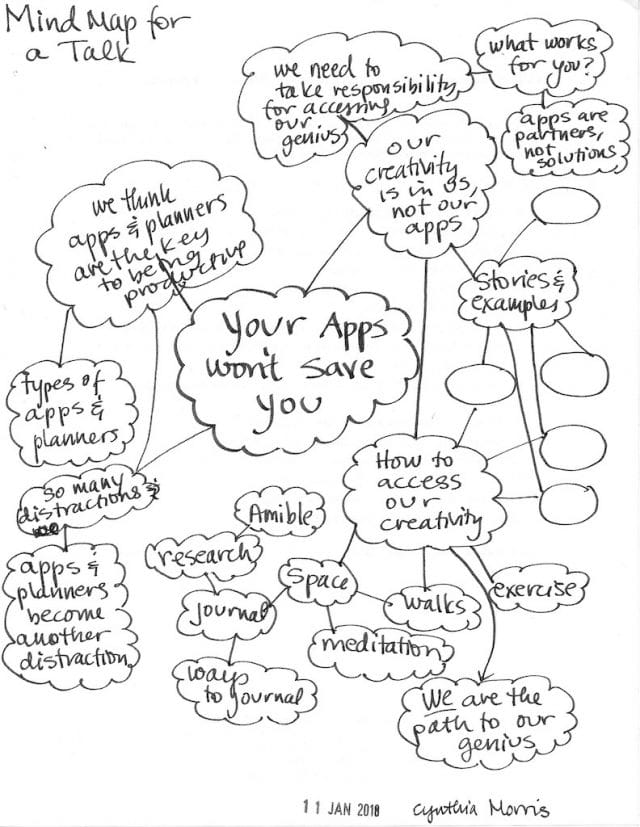
mind map topics speaker Cynthia Morris writing prompts

Here’s a mind map here of a talk I developed. I brainstormed the premise and ideas around this topic. You can see it’s messy, but that’s okay. The content is out of my head and onto paper and I can start writing, using each bubble as a prompt to get started.

Four ways to mind map

Try it for yourself, using mind mapping to generate a list of prompts. Here are a couple ways to experiment with that.

Method one: Simple piece of paper or notebook.

Method two: Gather sticky notes and a blank wall or large piece of paper.

Method three: Use index cards.  You may use several different colors, in order to color code different types of content that are in your book. Red for explication, green for example stories, yellow for exercises.

Method four: Use a digital mind mapping program like Milanote (which allows for exportable PDFS, unlike other programs, Simple Mind or Mindmeister.

Instructions for mind mapping your book’s topic on paper

I don’t use a mind mapping app because it’s just so fun and easy to use an analog process. I prefer the spaciousness that I feel when I am not looking at a screen.

Here’s my go-to method for developing writing prompts for my book using a paper mind map. 

Get a piece of paper. You can get a large one or just a piece of printing paper. In the center of a page, put the basic premise of your book in large letters. It’s helpful if you have a working title, but don’t fret if you don’t. If you are using sticky notes or cards, simply lay them out as you write ideas on each piece.

Now, brainstorm different things you want to say. There may be several large categories, each having its own bubble that comes off the central bubble.

For each category, capture the ideas you have for that category. Each idea has its own bubble, sticky note or index card. Don’t worry too much about organizing your ideas now; just get as many of them out as you can.

You can see from my mind map that the content isn’t completely organized. That’s okay. The organizing will come later, after I’ve drafted most of the pieces.

From here, I often move each item to an index card. This creates a deck of writing prompts that I can use to write from. The index card/sticky note process allows you to move your ideas around if you find they belong with a different category than you originally thought.

Keep playing with this until you are out of ideas. Go take a break and come back to see it anew. The mind map can be a living document that grows over time.

Inquiries for greater understanding:

  • What do you notice about your content?
  • Which categories have the most ideas?
  • Which ideas or categories feel most compelling to you?

Let this settle for a week or so, adding to it and moving things around until you feel you have most of your ideas on paper and where you want them to be.

Use mind mapping to get your ideas on one topic onto the page. This is a fun and non-linear way to gather your thoughts.

Final thoughts on mind mapping your book ideas

Write from each prompt until you’ve exhausted your ideas. This may take several writing sessions before you feel complete with the prompt. 

Remember that writing from these prompts is simply drafting or capturing your ideas. The writing will be rough, messy, and unorganized. It will feel incomplete and perhaps incoherent. Don’t fret! This writing will also be raw, real and fresh. It will have your voice and your conviction on it. It will be material that you will revise, edit and sculpt into something you can share with the world. But don’t get ahead of yourself with word smithing and perfectionism, either in developing your prompts or free-writing from them. 

Writing prompts can be simple. Don’t overthink them. The best part of free-writing is the surprises that emerge when you step aside and let your pen lead the way. Writing prompts can help you dive in and swim past the inner critic to write anything, anytime. 

To recap:

  1. Map your ideas on paper.
  2. Take the most juicy ideas and put them into a list or on index cards to use as prompts.
  3. Mind map each idea until you know what you want to say.
  4. Use each idea or bubble as a free-write prompt to get your thoughts onto the page.

What will you mind map now?

Filed Under: Creativity, The Writing Life Tagged With: mindmap

June 9, 2020 by Cynthia Morris 1 Comment

Writing as a power tool to end systemic racism

The protests of the horrible death of George Floyd and other black people in the US have finally brought our systemic racism to the surface in a way no one can ignore. I feel my own complacency has reached its expiration date.

It’s hard to see violence ripple through the world like this. And I know that massive change is often required to make the changes we need. Inertia, as you may well know, is a powerful force.

There is a feeling of hope that this time, finally, we are awake to the fact that the world needs to change. Is changing. If our constitution promises liberty and justice for all, that has to be more than lip service. This is going to take some work and each of us plays a part.

I don’t have answers for what you should do to end racism now. I know what I am doing. I’m taking a tip from my friend Jonathan Fields. He suggested that the anti-racism work we need to do is a practice. It’s not a donate once and done kind of situation. It’s ongoing work on ourselves and work in the world.

How? Let’s figure it out. Don’t ever let not knowing how to do something keep you from doing something.

Writing as a power tool

As your writing coach, I encourage you to use writing in every instance. Writing clarifies. Writing heals. Writing shows us a path forward.

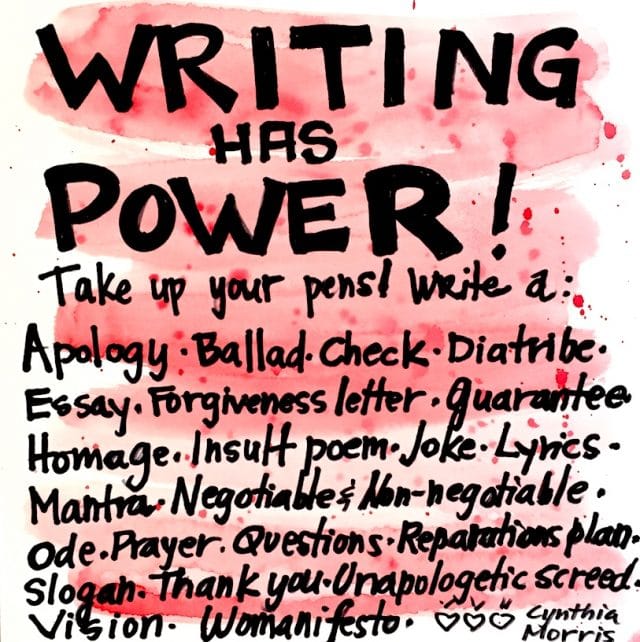
There are as many ways to use our words in this fight as there are words. Write a letter. Write a truth. Write an article. Write a confession. Write an apology. Write a commitment. Write a manifesto for a new world. Write a rant. Write a love letter.

writing has power to help be antiracist
Perhaps start with a free-write to get grounded and to get clear. Here are some bonus prompts I shared in The Devoted Writer salon this week:

  • Becoming an activist
  • How I lead
  • How I follow
  • My racism
  • Change and me
  • My addictions
  • Here’s what I want for the world
  • What I need now
  • My commitment to change

In my classes, we have talked many times about our emotions and how they impact our ability to write. I know many of us are having a hard time focusing on anything now. Hard to stop reeling and feeling and settle into any writing. That’s okay. Do what it takes to take care of yourselves. Do what you need for your writing. And do what we all need to make our world whole – do something to end racism.

I stand for peace and justice for all. I stand with Black Lives Matter and I commit to doing my part to end systemic racism in the US.

Do what is right for you, and if you feel like sharing the actions you are taking now, please do so in a comment below. I know that would inspire me and help me take more action.

Filed Under: The Writing Life

May 18, 2020 by Cynthia Morris 3 Comments

Organizing a Big Project: Coaching on Stumbling Toward Genius Ep 15

Most of our projects have many moving pieces. Trying to organize our ideas so we can bring them to life is almost always a challenge.

In this coaching episode of Stumbling Toward Genius, listen in while I coach Antonia Ruppert on how to bring more organization to her passion project.

You’ll hear us: 

        • Look at a simple way to gather ideas
        • Identify what’s important about the project
        • Consider possibilities to get feedback over the long term
        • And more. 

Antonia’s passion project – find out more and become part of it.

To book your life-changing coaching, click here. It’s easy to pay and schedule, and get the support you need to move your creative projects forward. 

Leave a comment below to share thoughts you have about this episode. If this episode brought to mind a friend who might benefit from this coaching session, please pass this episode on.

Stumbling Toward Genius is written, edited and produced by Cynthia Morris and Original Impulse. Show music by Evan MacDonald.

I’d be so grateful for your help with a review of the podcast Stumbling Toward Genius on iTunes.

Filed Under: Podcast

May 10, 2020 by Cynthia Morris Leave a Comment

Pop Up Writing Salon: Flash Fiction

Join us Friday, May 15th at 1:00 pm EDT for the no-cost Pop-Up Writing Salon. Our topic is Flash Fiction.

We gather for an hour or so, and spend most of our time writing together. We do not share our writing nor do we process our writing.

This week’s topic is FLASH FICTION. I have some great prompts for us to spark our innate creativity. We need it now! It’s this Friday May 15th at 1 pm EDT. Double check your time zone!!

Sign up here. If you have already signed up for the Pop-Up Writing Salon, no need to do so again. See you Friday!

Filed Under: The Writing Life

May 8, 2020 by Cynthia Morris Leave a Comment

Revitalize your writing practice (coaching) Stumbling Toward Genius EP 14

If you’re like most of us, your writing or creative practice ebbs and flows. How to get back into it?

In this live coaching episode of Stumbling Toward Genius, you get to listen in while I coach Erin on how to bring back the joy and dedication back to her writing.

You’ll hear us: 

    • Dispel the myth of when writing needs to happen
    • Questions to ask yourself to revitalize your writing joy
    • What makes it easier to get back into a writing practice
    • A simple exercise to get to the heart of what you want to write
    • And more. 

Mentioned in this episode: 

To book your life-changing coaching, click here. It’s easy to pay and schedule, and get the support you need to move your creative projects forward. 

For a written copy of the exercise mentioned in this episode, check out my book Create Your Writer’s Life. 

Leave a comment below to share thoughts you have about this episode. If this episode brought to mind a friend who might benefit from this coaching session, please pass this episode on.

Stumbling Toward Genius is written, edited and produced by Cynthia Morris and Original Impulse. Show music by Evan MacDonald.

I’d be so grateful for your help with a review of the podcast Stumbling Toward Genius on iTunes.

Filed Under: Podcast

May 7, 2020 by Cynthia Morris Leave a Comment

My favorite online yoga teachers

I’ve been practicing yoga for 24 years. I’ve had the great good fortune to have savvy guides for this practice. I certainly haven’t done it on my own in a room! I love yoga class. It’s were I am challenged, get my best ideas, get into my body, realize my strength. And, yoga class is where I met Steve.

online yoga teachersLately, Steve and I have been practicing online. I realized, hmmm, for the yoga teacher, this may be a good evolution. Having the chance to reach more people with your teaching is almost always a good thing. A Pay What You Can model can perhaps be a better way to pay teachers for the value of their time and expertise.

I want to share some of my favorite yoga teachers. Many of these people are friends and clients. Some I am helping to write their books. It’s been a delight to bring the yogini, writer and coach together to help with their projects.

Check out my favorite teachers and see whose style resonates with you.

Ashley Zuberi 

Brittany Belisle 

Chris Robbins Soul Degree 

Cindy Lusk 

De West 

Jeanie Manchester

Jeremy Wolf

Katherine Kaufman 

Soozie Kinstler

Filed Under: Creativity

  • « Go to Previous Page
  • Page 1
  • Interim pages omitted …
  • Page 9
  • Page 10
  • Page 11
  • Page 12
  • Page 13
  • Interim pages omitted …
  • Page 46
  • Go to Next Page »

Primary Sidebar

Join us in Paris!

Cynthia Morris novel Her Lisbon Colors

Let’s Connect

  • Email
  • Instagram
  • LinkedIn
  • Substack
  • YouTube
Finally be the creator you came here to be
  • This field is for validation purposes and should be left unchanged.

Copyright © 2026 Original Impulse. All Rights Reserved. Privacy Policies.