• Skip to main content
  • Skip to primary sidebar

Original Impulse HomepageOriginal Impulse

  • change your life
    • Book Coaching
    • Annual Review for Creatives
    • Write ON
    • Clear what’s in your way
    • Paris Sketchbook
  • About
    • About Cynthia
    • Successful Clients
    • Media
    • Speaking
  • Books
    • The Busy Woman’s Guide to Writing a Book
    • Her Lisbon Colors
    • Client Books
    • Books for Creatives
    • Book Recommendations
  • Contact

Cynthia Morris

June 10, 2020 by Cynthia Morris Leave a Comment

Use mindmaps to brainstorm your book’s topics for writing prompts

Perhaps you are working on a book or other big project. You want to get all your ideas out of your head so you can work with the material. Managing the contents of our books can be a real challenge. There’s so much to say, and we often wonder if we’re adding too much, zinging off on a tangent or making any sense at all.

Many people will recommend an outline, which makes sense. Most non-fiction books start from an outline, making it easier to fill in the table of contents with your writing.

But most of my clients don’t start there. Why not? Because an outline is an orderly, linear thing, and most of us don’t think in orderly, linear ways.

Use a mind map to visually lay out your ideas in one place. At a glance, you will be able to see the whole of your book, course curriculum or presentation. From the mind map, you can generate a list of prompts that you can free-write from.

Use mind mapping to:

  • outline the contents of your book
  • develop the contents of your courses
  • expand and distill your ideas on your topic for your blog or guest posts
  • plan your editorial calendar by month, quarter or year.
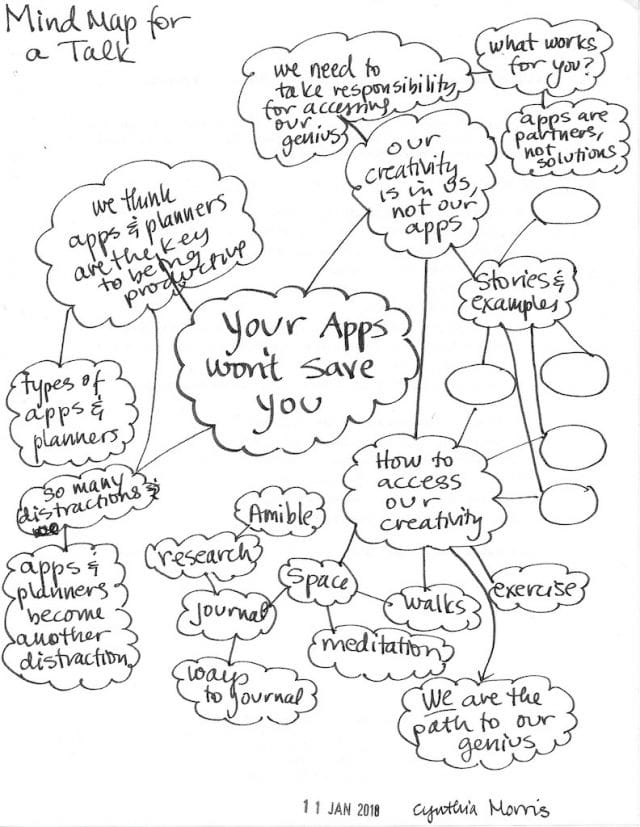
mind map topics speaker Cynthia Morris writing prompts

Here’s a mind map here of a talk I developed. I brainstormed the premise and ideas around this topic. You can see it’s messy, but that’s okay. The content is out of my head and onto paper and I can start writing, using each bubble as a prompt to get started.

Four ways to mind map

Try it for yourself, using mind mapping to generate a list of prompts. Here are a couple ways to experiment with that.

Method one: Simple piece of paper or notebook.

Method two: Gather sticky notes and a blank wall or large piece of paper.

Method three: Use index cards.  You may use several different colors, in order to color code different types of content that are in your book. Red for explication, green for example stories, yellow for exercises.

Method four: Use a digital mind mapping program like Milanote (which allows for exportable PDFS, unlike other programs, Simple Mind or Mindmeister.

Instructions for mind mapping your book’s topic on paper

I don’t use a mind mapping app because it’s just so fun and easy to use an analog process. I prefer the spaciousness that I feel when I am not looking at a screen.

Here’s my go-to method for developing writing prompts for my book using a paper mind map. 

Get a piece of paper. You can get a large one or just a piece of printing paper. In the center of a page, put the basic premise of your book in large letters. It’s helpful if you have a working title, but don’t fret if you don’t. If you are using sticky notes or cards, simply lay them out as you write ideas on each piece.

Now, brainstorm different things you want to say. There may be several large categories, each having its own bubble that comes off the central bubble.

For each category, capture the ideas you have for that category. Each idea has its own bubble, sticky note or index card. Don’t worry too much about organizing your ideas now; just get as many of them out as you can.

You can see from my mind map that the content isn’t completely organized. That’s okay. The organizing will come later, after I’ve drafted most of the pieces.

From here, I often move each item to an index card. This creates a deck of writing prompts that I can use to write from. The index card/sticky note process allows you to move your ideas around if you find they belong with a different category than you originally thought.

Keep playing with this until you are out of ideas. Go take a break and come back to see it anew. The mind map can be a living document that grows over time.

Inquiries for greater understanding:

  • What do you notice about your content?
  • Which categories have the most ideas?
  • Which ideas or categories feel most compelling to you?

Let this settle for a week or so, adding to it and moving things around until you feel you have most of your ideas on paper and where you want them to be.

Use mind mapping to get your ideas on one topic onto the page. This is a fun and non-linear way to gather your thoughts.

Final thoughts on mind mapping your book ideas

Write from each prompt until you’ve exhausted your ideas. This may take several writing sessions before you feel complete with the prompt. 

Remember that writing from these prompts is simply drafting or capturing your ideas. The writing will be rough, messy, and unorganized. It will feel incomplete and perhaps incoherent. Don’t fret! This writing will also be raw, real and fresh. It will have your voice and your conviction on it. It will be material that you will revise, edit and sculpt into something you can share with the world. But don’t get ahead of yourself with word smithing and perfectionism, either in developing your prompts or free-writing from them. 

Writing prompts can be simple. Don’t overthink them. The best part of free-writing is the surprises that emerge when you step aside and let your pen lead the way. Writing prompts can help you dive in and swim past the inner critic to write anything, anytime. 

To recap:

  1. Map your ideas on paper.
  2. Take the most juicy ideas and put them into a list or on index cards to use as prompts.
  3. Mind map each idea until you know what you want to say.
  4. Use each idea or bubble as a free-write prompt to get your thoughts onto the page.

What will you mind map now?
Filed Under: Creativity, The Writing Life Tagged With: mindmap

June 9, 2020 by Cynthia Morris 1 Comment

Writing as a power tool to end systemic racism

The protests of the horrible death of George Floyd and other black people in the US have finally brought our systemic racism to the surface in a way no one can ignore. I feel my own complacency has reached its expiration date.

It’s hard to see violence ripple through the world like this. And I know that massive change is often required to make the changes we need. Inertia, as you may well know, is a powerful force.

There is a feeling of hope that this time, finally, we are awake to the fact that the world needs to change. Is changing. If our constitution promises liberty and justice for all, that has to be more than lip service. This is going to take some work and each of us plays a part.

I don’t have answers for what you should do to end racism now. I know what I am doing. I’m taking a tip from my friend Jonathan Fields. He suggested that the anti-racism work we need to do is a practice. It’s not a donate once and done kind of situation. It’s ongoing work on ourselves and work in the world.

How? Let’s figure it out. Don’t ever let not knowing how to do something keep you from doing something.

Writing as a power tool

As your writing coach, I encourage you to use writing in every instance. Writing clarifies. Writing heals. Writing shows us a path forward.

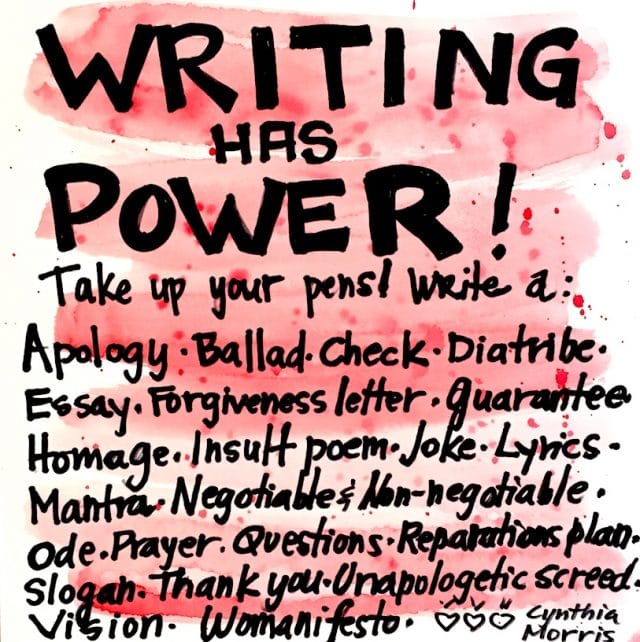
There are as many ways to use our words in this fight as there are words. Write a letter. Write a truth. Write an article. Write a confession. Write an apology. Write a commitment. Write a manifesto for a new world. Write a rant. Write a love letter.

writing has power to help be antiracist
Perhaps start with a free-write to get grounded and to get clear. Here are some bonus prompts I shared in The Devoted Writer salon this week:

  • Becoming an activist
  • How I lead
  • How I follow
  • My racism
  • Change and me
  • My addictions
  • Here’s what I want for the world
  • What I need now
  • My commitment to change

In my classes, we have talked many times about our emotions and how they impact our ability to write. I know many of us are having a hard time focusing on anything now. Hard to stop reeling and feeling and settle into any writing. That’s okay. Do what it takes to take care of yourselves. Do what you need for your writing. And do what we all need to make our world whole – do something to end racism.

I stand for peace and justice for all. I stand with Black Lives Matter and I commit to doing my part to end systemic racism in the US.

Do what is right for you, and if you feel like sharing the actions you are taking now, please do so in a comment below. I know that would inspire me and help me take more action.

Filed Under: The Writing Life

May 18, 2020 by Cynthia Morris 1 Comment

Organizing a Big Project: Coaching on Stumbling Toward Genius Ep 15

Most of our projects have many moving pieces. Trying to organize our ideas so we can bring them to life is almost always a challenge.

In this coaching episode of Stumbling Toward Genius, listen in while I coach Antonia Ruppert on how to bring more organization to her passion project.

You’ll hear us: 

        • Look at a simple way to gather ideas
        • Identify what’s important about the project
        • Consider possibilities to get feedback over the long term
        • And more. 

Antonia’s passion project – find out more and become part of it.

To book your life-changing coaching, click here. It’s easy to pay and schedule, and get the support you need to move your creative projects forward. 

Leave a comment below to share thoughts you have about this episode. If this episode brought to mind a friend who might benefit from this coaching session, please pass this episode on.

Stumbling Toward Genius is written, edited and produced by Cynthia Morris and Original Impulse. Show music by Evan MacDonald.

I’d be so grateful for your help with a review of the podcast Stumbling Toward Genius on iTunes.

Filed Under: Podcast

May 10, 2020 by Cynthia Morris Leave a Comment

Pop Up Writing Salon: Flash Fiction

Join us Friday, May 15th at 1:00 pm EDT for the no-cost Pop-Up Writing Salon. Our topic is Flash Fiction.

We gather for an hour or so, and spend most of our time writing together. We do not share our writing nor do we process our writing.

This week’s topic is FLASH FICTION. I have some great prompts for us to spark our innate creativity. We need it now! It’s this Friday May 15th at 1 pm EDT. Double check your time zone!!

Sign up here. If you have already signed up for the Pop-Up Writing Salon, no need to do so again. See you Friday!

Filed Under: The Writing Life

May 8, 2020 by Cynthia Morris Leave a Comment

Revitalize your writing practice (coaching) Stumbling Toward Genius EP 14

If you’re like most of us, your writing or creative practice ebbs and flows. How to get back into it?

In this live coaching episode of Stumbling Toward Genius, you get to listen in while I coach Erin on how to bring back the joy and dedication back to her writing.

You’ll hear us: 

    • Dispel the myth of when writing needs to happen
    • Questions to ask yourself to revitalize your writing joy
    • What makes it easier to get back into a writing practice
    • A simple exercise to get to the heart of what you want to write
    • And more. 

Mentioned in this episode: 

To book your life-changing coaching, click here. It’s easy to pay and schedule, and get the support you need to move your creative projects forward. 

For a written copy of the exercise mentioned in this episode, check out my book Create Your Writer’s Life. 

Leave a comment below to share thoughts you have about this episode. If this episode brought to mind a friend who might benefit from this coaching session, please pass this episode on.

Stumbling Toward Genius is written, edited and produced by Cynthia Morris and Original Impulse. Show music by Evan MacDonald.

I’d be so grateful for your help with a review of the podcast Stumbling Toward Genius on iTunes.

Filed Under: Podcast

May 7, 2020 by Cynthia Morris Leave a Comment

My favorite online yoga teachers

I’ve been practicing yoga for 24 years. I’ve had the great good fortune to have savvy guides for this practice. I certainly haven’t done it on my own in a room! I love yoga class. It’s were I am challenged, get my best ideas, get into my body, realize my strength. And, yoga class is where I met Steve.

online yoga teachersLately, Steve and I have been practicing online. I realized, hmmm, for the yoga teacher, this may be a good evolution. Having the chance to reach more people with your teaching is almost always a good thing. A Pay What You Can model can perhaps be a better way to pay teachers for the value of their time and expertise.

I want to share some of my favorite yoga teachers. Many of these people are friends and clients. Some I am helping to write their books. It’s been a delight to bring the yogini, writer and coach together to help with their projects.

Check out my favorite teachers and see whose style resonates with you.

Ashley Zuberi 

Brittany Belisle 

Chris Robbins Soul Degree 

Cindy Lusk 

De West 

Jeanie Manchester

Jeremy Wolf

Katherine Kaufman 

Soozie Kinstler

Filed Under: Creativity

April 28, 2020 by Cynthia Morris Leave a Comment

Your writing practice could help your sanity now

You probably know that writing has sustained my sanity and creativity for a long time now. And, it’s my mission to help people craft a writing practice that honors them and serves their writing dreams and goals.

I was poking around online recently to see what people were saying about a journaling practice. I found an article on the New York Times:

What’s All This About Journaling: One of the more effective acts of self-care is also, happily, one of the cheapest  by Hayley Phelan

The following two paragraphs blew me away. I know the benefits of regular writing firsthand, and I have seen hundreds of people’s lives change as a result of the practice. But I’d never thought of writing this way:

“….writing is fundamentally an organizational system. Keeping a journal, according to Dr. Pennebaker, helps to organize an event in our mind, and make sense of trauma. When we do that, our working memory improves, since our brains are freed from the enormously taxing job of processing that experience, and we sleep better.

This in turn improves our immune system and our moods; we go to work feeling refreshed, perform better and socialize more. “There’s no single magic moment,” Dr. Pennebaker said. “But we know it works…”

(Emphasis mine; James W. Pennebaker is a social psychologist at the University of Texas at Austin who is considered the pioneer of writing therapy.)

The cool thing about a journaling or writing practice is that it can do so many things. We can write to refresh and release. We can write our way to clarity. We can write from our imaginations and for our work.

If you haven’t been writing, I invite you to pick it up today. Don’t do it ‘right’. Don’t do it my way. Do it your way and let your pen lead you closer to yourself and what you want for your life.

There’s still room for you in our online writing salon, The Devoted Writer. We’ve only just begun and already people are savoring the positive effects. Like Patricia Mauerhofer, who shared in our salon:

“I am soooo grateful and happy for being here and having signed up…7 days and my playful creativity juices are starting to flow again.I also became aware why writing just a little every day is good enough for now.”

Writing every day isn’t the goal; being connected to ourselves through a writing practice is our focus. Some people are working on projects, others are writing just for themselves.

Join us here.

Do you have a writing practice that honors you? Share in a comment below one thing that helps you connect to your writing practice. 

Filed Under: The Writing Life

April 15, 2020 by Cynthia Morris Leave a Comment

Creative Practice: Do It Daily: Stumbling Toward Genius Episode 13

Have you ever wondered what doing a project for 100 days would be like? If you’re feeling creatively stuck, a daily challenge could be a great way to revive your creative pulse.

In this episode of Stumbling Toward Genius, Cynthia shares her experience with daily projects. Cynthia:

  • shares her spectacular failures and surprising wins
  • suggests ways to design a daily project that suits you
  • invites you to the best writing party of the summer.

Listen in and get inspired to do your own daily creative practice.

Leave a comment below to share thoughts you have about this episode. If this episode brought to mind a friend who might benefit from a daily practice, please pass this episode on.
Links to things and people mentioned in the show
Stumbling Toward Genius is written, edited and produced by Cynthia Morris and Original Impulse. Show music by Evan MacDonald.
I’d be so grateful for your help with a review of the podcast Stumbling Toward Genius on iTunes.

Filed Under: Podcast

April 13, 2020 by Cynthia Morris Leave a Comment

Pop-Up Writing Salon: Pleasure

Join us Thursday April 16 for the no-cost Pop-Up Writing Salon.

We gather for an hour or so, and spend most of our time writing together. We do not share our writing nor do we process our writing.

This week’s topic is creativity. I have some great prompts for us to spark our innate creativity. We need it now! It’s this Thursday at 1 pm PDT, 2:00 pm MDT, 3:00 CET, and 4:00 EDT. Double check your time zone!!

Sign up here. If you have already signed up for the Pop-Up Writing Salon, no need to do so again. See you Thursday!

Filed Under: The Writing Life

April 1, 2020 by Cynthia Morris Leave a Comment

Design Your At-Home Writing Retreat: Stumbling Toward Genius Episode 12

Stuck at home, we may feel an urge to do some writing on a project. But it’s hard to focus with so many distractions. Wouldn’t it be great to slip away to a deserted island to enjoy a writing retreat?

Alas, we may not always be able to nip off somewhere. In this episode of Stumbling Toward Genius, Cynthia shares some suggestions for designing an at-home writing retreat that feels great for you. Cynthia:

  • Busts the time myth: It’s not how long it is, it’s how much you can focus
  • Offers before, during and after guidelines
  • Shares a simple tool for diving into the writing.

Plan your own writing retreat easily.

Leave a comment below to share thoughts you have about this episode.

Stumbling Toward Genius is written, edited and produced by Cynthia Morris and Original Impulse. Show music by Evan MacDonald.

I’d be so grateful for your help with a review of the podcast Stumbling Toward Genius on iTunes.

Filed Under: Podcast

March 25, 2020 by Cynthia Morris Leave a Comment

Pop-Up Writing Salon: Creativity

Join us Friday March 27th for the no-cost Pop-Up Writing Salon.

We gather for an hour or so, and spend most of our time writing together. We do not share our writing nor do we process our writing.

This week’s topic is creativity. I have some great prompts for us to spark our innate creativity. We need it now!It’s this Friday at 10 am PDT, 11:00 am MDT, 12: CET, and 1:00 EDT. Double check your time zone!!

Sign up here. If you have already signed up for the Pop-Up Writing Salon, no need to do so again. See you Friday!

Filed Under: Creativity, The Writing Life

March 25, 2020 by Cynthia Morris Leave a Comment

How to Focus When It Feels Impossible: Stumbling Toward Genius Episode 11

In this episode of Stumbling Toward Genius podcast, I try a new format. If you struggle with focus even in the best of times, this will help you garner some focus even when the world seems crazy.

Creative FocusIn this episode of Stumbling Toward Genius, you’ll hear why I revived the podcast and changed the format.
You’ll get actionable insights into how to focus when focus feels impossible. Including:

  • What you might need to add to your process
  • A contrarian view on setting expectations
  • A couple of ways I make focus easier now
  • Creative Competency: build up your focus from zero.

Mentioned in this episode:

Omm Writer, a software that shuts down internet access so you can focus.

The Busy Woman’s Guide to Writing a World-Changing Book

Stumbling Toward Genius is written and produced by Cynthia Morris and Original Impulse. Engineering by Cynthia Morris. Show music by Evan MacDonald.

I’d be so grateful for your help with a review of the podcast Stumbling Toward Genius on iTunes.

Filed Under: Podcast

March 17, 2020 by Cynthia Morris 4 Comments

Design Your At-Home Writing Retreat

Stuck at home? Your writing can be a haven in this time. Yet it can also be hard to drop in and find focus.
I made a tutorial with suggestions for designing an at-home writing retreat. It could be short, it could be all day. However long your retreat is, make it work for you.

Filed Under: The Writing Life

March 13, 2020 by Cynthia Morris Leave a Comment

Stop the self-censorship!

Usually, the first person in the way of letting ourselves create what we want is US! This self-censorship is painful and unhealthy. I offer a few ways to stop this so you can write and make what you want.

Filed Under: Creativity, The Writing Life

March 12, 2020 by Cynthia Morris Leave a Comment

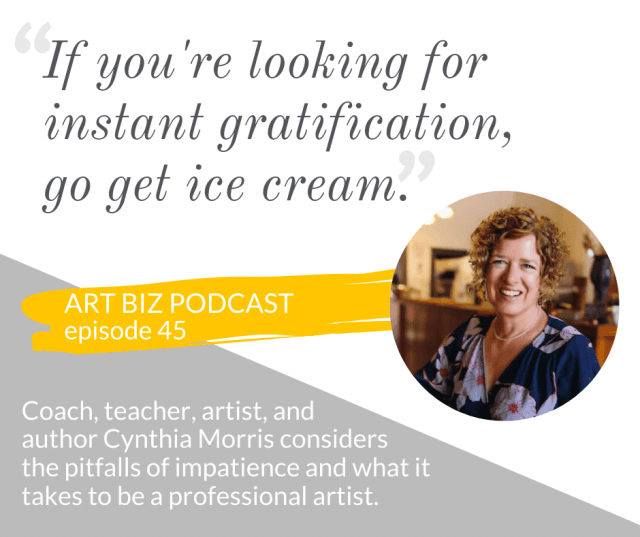
The Impatient Artist: How Much Time Will Your Art Career Take? Podcast with Alyson Stanfield

I am always happy to talk with friend and colleague Alyson Stanfield of Art Biz Success. I’ve worked with her for years to help her artist clients have successful businesses on their own terms.

Alyson recently reposted this podcast interview with me about how to build an art career, one patient step at a time. Enjoy!


Filed Under: Creativity

  • « Go to Previous Page
  • Page 1
  • Interim pages omitted …
  • Page 10
  • Page 11
  • Page 12
  • Page 13
  • Page 14
  • Interim pages omitted …
  • Page 47
  • Go to Next Page »

Primary Sidebar

A great escape read!

Cynthia Morris novel Her Lisbon Colors

Let’s Connect

  • Email
  • Instagram
  • LinkedIn
  • Substack
  • YouTube
Finally be the creator you came here to be
  • This field is for validation purposes and should be left unchanged.

Copyright © 2026 Original Impulse. All Rights Reserved. Privacy Policies.