• Skip to main content
  • Skip to primary sidebar

Original Impulse HomepageOriginal Impulse

  • The Writing Life
    • Coaching for writers
    • Write ON
    • The Busy Woman’s Guide to Writing a Book
    • Blog
  • Workshops
    • Events
    • An Illustrated Feast
    • Paris Sketchbook
    • Write ON
  • Speaking
  • Books
    • Her Lisbon Colors
    • Client Books
    • Books for Creatives
    • Book Recommendations
  • About
    • About Cynthia
    • Successful Clients
    • Media
  • Contact

The Writing Life

August 31, 2022 by Cynthia Morris Leave a Comment

Let me help make writing your book WAAAAAAAY easier

You will resist this but pretend you’ve just paid me thousands of dollars and my advice is GOLD.

Identify your reader early on. Know your reader, not just from a marketing perspective but from a writing perspective. Often when we sit down to write, we get overly formal and lose touch with our voice and our confidence.

If you have a business, you have identified your ideal client or customer.

When we know our reader, we can write directly to them. The connection between you, your ideas, and your reader is powerful. With a specific person in mind, your writing will flow. Decisions about what goes in the book will become super easy.

And yet, you will resist it. You will want the book to be for everybody. You will think of three or more audiences who will love your book.

But it’s not for an “audience.” When you think of that word, what comes to mind is probably a bunch of people or a big group. But when you think of one specific person, writing your book is infinitely easier. Trust me.

Have you identified your reader for your book or other writing? This isn’t needed as much for fiction but for non-fiction, yes, this is a power move.

Bonus homework from your writing coach

Free-write about your ideal reader. Who needs your book? They will recognize it immediately when they see it. Give them a name. Get very clear about who they are and why your book is important to them.

After you went through your homework, share your comments below.
Filed Under: The Writing Life

August 17, 2022 by Cynthia Morris Leave a Comment

Why you must write your book

I promised my coachy genius in this week’s Impulses to help you get over inner critic POO POOing and write the book that’s inside you.

But first you may be asking, Who is Cynthia Morris to talk about writing a book? Some stats:

Reading books for 50 years. (Doesn’t qualify me around writing a book, but I do have unquenchable booklust. )

Wrote and published 8 books, including a novel.

Writing my 9th book now.

I’m a Certified Co-Active Professional Coach since 1999, focused on writing and creative process.

Former bookseller (Again, doesn’t qualify me about writing but gives me insider view to the book world.)

I’ve been coaching writers and creatives since 1999 = thousands of conversations to discover a) the path we all must hike when writing a book + b) how we all have to hike it in our own way.

Okay, here are a few of my best coaching inquiries to help you truly commit to your book writing. Give yourself a few minutes to answer these questions on your own. Respond in writing, without overthinking.

  1. What’s important to you about your subject?
  2. Why MUST you write about it NOW?
  3. What if it doesn’t have to be a ‘book’? Consider it a body of work that could be used in many ways. (Written series, audio, coursework or a program…) Unhooking from the enormity of a ‘book’ can make it easier to write.
  4. What will you set aside to make space to write your book? (No one seems to think about the need to make space.)

Are you in for the Impulse Writing Club?

Registration for the Impulse Writing Club is still open. Want to join us for 16 weeks of writing? We start next week. Register today!

Share your comments below.

Filed Under: The Writing Life

August 10, 2022 by Cynthia Morris Leave a Comment

Let’s hijack the voice in your head that says don’t bother writing your book

My answers to last week’s questions that will actually get you writing your book.

Let’s hijack the voice in your head that says don’t bother writing your book.

Yes, the world needs YOUR book. Other books reflect proof of concept. Your voice will add to the conversation.

There’s only one way to find out if you can do it – try it and see. Really. Isn’t it better to give it a chance than to wonder what if for the rest of your life?

If you care about your idea, chances are, someone else will, too. And honestly, you are writing the first draft for yourself in most cases.

Choose the book that feels most alive to you and start there.

Don’t fret about finishing; just get started. Worse than not finishing is the pain of never giving your ideas a chance.

Which one of these statements/actions most ignites you to write your book? Share in the comments below.

Next week I will share my true coachy genius that gets people motivated, ready and in action around writing a book.

Share your thoughts in the comments below.

Filed Under: The Writing Life

August 3, 2022 by Cynthia Morris 1 Comment

Five unhelpful questions keeping you from writing your book

I want to be sure you know about the Impulse Writing Club August 25 – December 15

Every Thursday, I gather with writers to have a ‘writing jam’ for an hour. We write whatever we want. Some people work on their books or articles. Others write off the top of their head, letting whatever needs to flow to flow.

This is the Impulse Writing Club. It’s so simple, and yet so profound. Here are some of the comments at the end of a recent session:

“I feel a strong, positive mood shift.”

“Working alone is not as good as writing with others.”

“Profound insights – I’m grateful!”

“This was freeing. I feel lightness of heart and more energy.”

We meet every Thursday through December 15. (Except on Thanksgiving!) So far this year I have drafted my book and many articles during these weekly writing jams. We don’t share our work and we don’t waste time on chitchat.

If you could use this kind of weekly writing focus, get a subscription and join us! All the details are here to join.

Unhelpful questions stopping you from writing 

I like to get in your head and listen to the things that prevent you from writing your book. Just kidding! But after decades of coaching conversations with writers, I do see patterns.

See if any of these questions prevent you from writing your book

Does the world need another book on my topic?

Do I have what it takes to write a book?

Will anyone care about my idea?

Should I write this book or that book?

What if I don’t finish it?

Do these questions get in your way? What question do you ask yourself that does not help you to write? Share the doubts that stop you in the comments below.

Next week, I will share my answers to these questions. They will be my voice in your head that will remind you that yes, if you have the impulse to write, you must follow it.

Filed Under: The Writing Life

July 27, 2022 by Cynthia Morris 14 Comments

Who would you be if you didn’t write?

I love the question I’m asking today. It’s one of those that’s impossible to answer. 

I ask it because I always want my clients to feel and appreciate the impact writing has on their days. 

At the end of my Impulse Writing Club sessions, I invite writers to jot three words that describe their state of being. We do this at the beginning, too, to see a contrast between before and after writing. 

Atelier

This notion of who you would be if you didn’t write is really at the core of why I help people bring their ideas into form. I think the projects we harbor but don’t do have a negative impact on us. 

What if this were the time for you to focus on your project? Perhaps all you need is a supportive container to keep you on track. 

Applications are coming in for the Atelier. This eight-month program gives you all the insight you need about your process so you can keep going with your project. Find out how you can be part of it here. 

Writing to Heal 

I have been writing steadily since 1994. I’ve written poetry, plays, dramatic monologues, a novel, non-fiction books, short stories, video and podcast scripts, and articles about the creative process.

Can you even imagine who I would be if I did not have this inky channel to get my thoughts and feelings out onto the page?

I imagine a dark, crowded, cluttered garage full of unprocessed ‘stuff’ and unacknowledged ideas. I imagine I would be a very cranky, mentally and emotionally constipated person.

So of course I loved Nancy Slonim Aronie’s book Memoir as Medicine. I work with a lot of people who are writing pieces of their life story.

Most people want to get their experiences onto the page to help others. But in the process of writing their stories, they are transformed. Nancie’s book offers a great range of short, poignant exercises to help us come to the page with new eyes and fresh angles.

If you have been wanting to write your stories down to get them out and unclutter your inner landscape, Nancie’s book is a great resource.

You don’t have to want to write a whole memoir or book to use this helpful book full of prompts.

If you want to write, please do it. Make it easy on yourself to pick up a pen and ink your ideas.

Meanwhile, share your thoughts in the comments below.

Filed Under: The Writing Life

January 26, 2022 by Cynthia Morris Leave a Comment

Write Your Book This Year

Have you been waiting to write your book? I assert that now is the time to get that idea off the shelf and into your heart. Now is the time to pick up the long-held dream of writing your book and let it go. Let it go onto the page. Let your ideas become ink. Let your ink roll into sentences. Let your sentences form into paragraphs that lead up to the holy container of a chapter. Let your chapters pile up in the best way into the shaggiest, most glorious draft of a book. A manuscript.

If you hesitate, I ask you:

  • What are you waiting for?
  • Who will give you permission?
  • How will you know you are good enough?
  • When will you know that you are ready, that you are able to finally write that book that has been haunting you?
  • What would your year feel like if you were writing your book?

I am not here to try to convince anyone that they should write a book. I am speaking to you – the person who wants to write a book, the person who has always wanted to be an author.

I will be working on a book that has been on my to-write shelf for way too long. It’s outlined, it’s sketched out. It still speaks to me. It still calls me. It got a fancy new title and concept and I’m excited to get going and put some flesh on those skeletons.

When I think of writing this book – and painting it, because it will be illustrated – I get so excited. I love thinking of having a year devoted to this book.

What book is waiting inside you to be let out to play? What concepts are eager for you to explore them?

Perhaps you need and want support to make this long-held dream a vibrant reality. Perhaps you don’t know how to start, and more importantly, how to keep going. I’ve got just what you need.

My book, The Busy Woman’s Guide to Writing a World-Changing Book will guide you through writing your book.


Filed Under: The Writing Life

December 24, 2021 by Cynthia Morris Leave a Comment

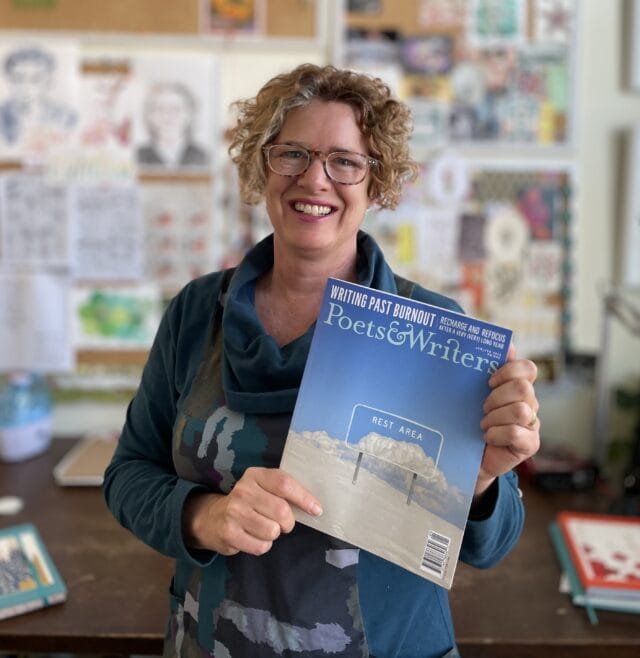
The Gift of Less Struggle: My illustration in Poets & Writers Magazine

If I could give a life-changing gift to all writers and artists, this is it: your inner battle around creating is over. You have a new, positive relationship with yourself and your creativity. Your inner demons are ever-present, but you interact with them in a way that empowers you to create. You know your inner allies and they encourage you to keep going despite setbacks. 

Poets & Writers Cynthia Morris illustration This gift is in the two-page illustration in the new issue of Poets & Writers magazine.

I was thrilled when they invited me to do a two-page illustration for their Inspiration issue. I worked with editor Emma and editor-in-chief Kevin to develop the interactive spread of Writers’ Demons & Angels. It’s full of exercises for you to get to know and relate anew with the forces that prevent and support your writing and creativity. 

This is my life’s work: to help people create more and struggle less. This spread is my gift to you as you enter 2022. Have fun with it and let me know how its magic works on your creative life. 


Filed Under: The Writing Life

March 16, 2021 by Cynthia Morris 11 Comments

The Impact of Writing our Travel Stories: Lifelong Traveler and Diarist Molly Nunnelly

I spoke recently with Molly Nunnelly about her travel writing. I’m curious about how writing about our travels enhances our experience. Molly’s travel consultancy is called Heirloom Vacations. She understands the power of our memories to shape our experiences long after a trip has ended.

Here’s what Molly shared with me in a written and verbal interview.

“I have always been a diarist, keeping personal journals from the time I was young. On my first trip to Europe as a teenager, my father gave me a travel journal and told me he would like to read it after my trip! I dutifully kept that journal and have pretty much kept one on every trip since then.”

What a great gift to receive! I, too, got a travel journal – Banana Republic put one out with a leather cover. I think that got me into writing about travel, too.

I asked Molly how she started her blog at Heirloom Vacations. It’s full of stories, inspiration, and images that make me want to travel more!

“I started writing a blog about my travels because I had a bad experience with a travel supplier,” Molly said. “I felt the need to warn others about this operator. After that, I wrote about my trips and how I organized them.”

Writing our travel stories both for ourselves and others gives us new perspectives and the chance to relive and reframe our adventures. Here’s what Molly said writing her travels has done for her.

“Writing about my travels crystallizes the experiences. Rereading my journals brings back memories that I’ve forgotten, which is great as I get older. I have also learned that I like adding art and ephemera to my journals.

I wondered if Molly sees a difference in the way she travels as a result of keeping a journal. I know I pay attention more and have a process that makes it easy to capture things while on the move. Sure enough, keeping a blog and journal made a difference in her life.

“Over time, I noticed that I pay attention to different things because of the journals. I notice more how I feel rather than just recounting what we did. I always find time and space on my trips and afterward to fill in my pages.”

Thanks for sharing your experience, Molly! I believe in the power of writing to elevate and transform our experiences. We’re bringing our ink to our stories in the upcoming Write Your Travel Stories. Class starts on March 22nd, so get your ticket today!

Filed Under: The Writing Life

March 4, 2021 by Cynthia Morris Leave a Comment

Writing, Travel and Transformation with Chandi Wyant

I had the pleasure of connecting recently with Chandi Wyant, author of Return to Glow: A Pilgrimage of Transformation in Italy and licensed tour guide in Florence Italy. We talked about the effect writing about our travels has on us.

Chandi has been an avid traveler since the age of 19. “I always kept a journal and wrote letters home,” she said. 

“That’s one level of writing – recording your experiences. Writing a travel memoir is a whole other level. I had to go beyond the details and drop into my heart,” Chandi said. “I also had to break away from my academic writing and learn the craft of memoir.”

A lot of my clients are writing a memoir, so this conversation resonated with me. I know how much it takes to be honest and vulnerable in our writing. It’s a different kind of courage than we use when traveling. It’s the inside journey and we have to expose ourselves in ways we aren’t accustomed to. And yet, there are rewards to the work of writing authentically.

“I learned so much about myself through writing this memoir. The process was deeper, more profound, and more helpful than therapy,” Chandi told me. 

I get it! My writing and my travels have shaped me in so many ways. My best gift from travel has been courage. With the boldness I’ve gained from crossing the world by myself many times, I know I can brave the blank page to honestly write my stories.

“You have to be willing to dig deep and be vulnerable,” Chandi said. She mentioned this powerful quote by Brené Brown: “Courage is to tell your story with your whole heart.” I agree.

What about you? How has writing about your travels transformed you?

Take a bold trip with us in Write Your Travel Stories. This fun writing workshop will be the adventure you’ve craved. Get on board here. 

Get Chandi’s memoir, Return to Glow here and find out more about her Italian adventures at Paradise of Exiles.

Filed Under: The Writing Life

March 2, 2021 by Cynthia Morris Leave a Comment

New Writing Workshop! Write Your Travel Stories

I haven’t been out of Colorado for a year now. Thinking of travel, missing Paris, just made me sad all last year. As I was planning my workshops for 2021, I considered bringing back a travel writing class I taught and loved – Write Your Paris Stories.

But what about other destinations? What if we wrote our global travel stories? And voila, a new class was born: Write Your Travel Stories. 

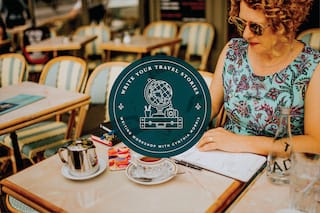
Write your travel stories workshop with Cynthia Morris

I am designing an incredibly fun curriculum for Write Your Travel Stories.

It’s for you if you want to:

  • turn your wanderlust into something creative.
  • write your travel memories down but don’t consider yourself a writer.
  • have some fun this spring as a traveler but don’t leave the safety of home.

The multi-media curriculum engages all our senses and our creativity. It’s easy, playful, and focused on having FUN.

You can find out all about it here, where I also share the syllabus. We start in mid-March, but there is an early boarding deal that you won’t want to miss out on.

I do hope you join us for the fun! And travel is always better with a buddy, so pass this on to a travel friend!

Filed Under: The Writing Life

October 14, 2020 by Cynthia Morris 5 Comments

How a hedonist can be wildly productive

It’s the time of year when I have a lot on my plate. I get to work with my 1:1 coaching clients and my Atelier clients. I have a great group of people in my Devoted Writer workshop. I just launched a private art studio space where I invite patrons into my art process. And I am working on a major writing project with a December 18th deadline. I’m also volunteering with Denver Food Rescue, Denver Metro Caring, and will be training this weekend to be an election judge.

Plus living life, trying to stay in touch with family and friends, maintaining my health and well-being, and savoring the final weeks of my garden. And oh, the world’s shitnanegans to process, too, mainly emotions about the election.

I don’t say any of this to say, Oh look at me, I’m so busy! We were discussing the toxicity of busy culture in the Atelier the other day. I don’t subscribe to busyness as a good thing. And I also don’t intend to overburden myself so I feel like a victim and can’t enjoy my good fortune.

My plate is full because I work seasonally. I take ‘summer hours’, where I have less on my schedule so I can be offscreen and in the world. It was a lovely summer – well, it was a shitty summer, let’s be honest. But the space I gave myself allowed me to enjoy the realities of the present moment – time in my garden, watching things grow, and space to rest and process all the changes we’re experiencing.

One of my art patrons said How do you find time to do it all, Cynthia? I’m not super organized or disciplined. I don’t have a ‘team’ to delegate stuff to – it’s all me. I’m a lover of life with a tendency toward hedonism. I don’t believe in discipline as a way to be productive. So how do I do all this? Read on…

Helping people live their lives according to their values and priorities is at the core of my work as a coach. I believe that when we align with our way of being, we work and create with way less friction. I am not perfect. I am a work in progress. Being attentive to my strengths, needs, and weaknesses allows me to be productive and also to rest and enjoy life.

Some of my weaknesses include the following – are like this, too?

When I feel overwhelmed with projects, I immediately want/tend to add more. It’s the craziest thing. Usually, I can rein myself in but sometimes I need to hang up a sign that says ADD NO MORE. (I need that right now!)

I don’t tend to procrastinate, because I much, much, much prefer the feeling of getting something done over avoiding things. I’m a wuss and can’t bear the pain that comes with avoiding things. 

But this year, it’s been easy to let my precious focus dissipate by reading news, newsletters, or other whatnot. Yikes!

It’s easy to get distracted when I have a lot of things going at once. I actually thrive on the variety, but sometimes I commit to too many things.

There are more weaknesses, but let’s look at how I manage to be productive and sane.


First, I remember how good it feels to do what I say I will. Integrity is one of my top values, and when I live according to my values, I feel great, even when things around me are in the pooper.

I have a loose schedule that honors my different roles. Today is a client day. I get to meet with clients all morning and afternoon. I don’t have to do or think about anything else. I get to just be with them and be present.

This single focus reduces stress. I have time committed to the other roles I play. Keeping my promises to myself to show up for the other projects is key to making this work. 

Knowing that I have full client days this week, I spent Monday diving into my project. I needed to make serious headway in order to be able to focus with my clients and feel the integrity of walking my talk.

I dedicate the weekends to my art and my art studio guests. I know that during the week when I am at work, my artist will have her due and I will connect with my guests. It was tough last weekend. We were doing some deep cleaning of the nest, and that threatened my studio time. I had to put my foot down and take studio time first. I did my dusting and then had another session at the art desk.

I also sneak up on myself. I wrote about this productivity hack last year. It’s the best way to get stuff done. You may have notions about how much time you need to get things done. We often claim that we need time to get into the zone. We don’t like doing a little bit of writing and then being pulled away. Fair enough. I get it. There are certainly times when we need space to think and write things through.

And then there are times when we can sneak 15 minutes in. You’ve heard me say that productivity is less about time management than focus management. When I worked on my writing project last week, I had to go to the park, take nothing else with me, and set a timer for 15 minutes. Then I set it for another 15. I got 30 solid minutes in on the project. This leads to the next thing that helps me get stuff done.

I appreciate every single freaking drop of work that I show up for. The other day, I got one page of edits on my project. ONE! Measly, right? But I was jubilant. I felt the joy and self-respect of having done something. Because truly, every little bit counts. Most of the people I’ve worked with battle a part of themselves that won’t let them appreciate progress. One page completed just brings mockery or disappointment.

Friends, there is always more to be done. We never do as much as we want or expect. Consider this mindset of lack to be a frantic gerbil wheel of pain kept rolling by a patriarchal system that doesn’t want us to relax, ever. Don’t get on it! Give yourself credit for each little bit that allows you to live your values, feel good about your choices, and make progress on whatever you’re committed to.

A couple of other things


I do my personal writing in the morning, with meditative music, before I go to the computer. This journaling time grounds me and connects me to myself. It takes no more than 15 minutes.

I don’t have children, which frees up a lot of bandwidth. If you do have children or people you care for at home, you might need to lower your expectations for now.

I don’t allow clutter in my space. That drains me and overwhelms me. I keep things tidy.

I don’t expect to get things right on the first pass. This lowering of the bar allows me to get stuff done rather than being put on the sidelines by my inner critic.

Finally, I rest. On weekends, I make a list of things I want to do. This usually includes a long walk with Steve, yoga, time in the art studio and garden. Also cooking and reading and puzzle play. There will always be a segment of the weekend where I am lounging around reading.

This may not sound like rest, but for me, any time away from a screen is restful.

Giving myself space to rest is vital to my productivity. If I am going all the time, I get resentful and cranky.

I could go on, but you and I have other things to do! I snuck up on myself to draft this newsletter for you. I could easily have blown it off to later, but I knew that would bring more stress. I snuck in 20 minutes to write this using free-writing, and I snuck in another 20 to edit and polish it up for you. I am going into my client calls feeling huge relief that I made progress on this instead of stress that I didn’t get it done.

Listen, I am no saint and don’t pretend to be. I should call my mom more, spend more time with friends, and do more volunteering. But I’m also not into self-abuse and honestly, I am a hedonist. I want to live each day doing my work with as little self-inflicted pain as possible. 

I am feeling the pain, tension, and stress in the world. Doing the things that allow me to live my values and feel a sense that I am contributing help me. Avoiding my work, both the paid and unpaid work, just makes me feel bad. It’s not discipline that motivates me. It’s seeking goodness as much as I can.

These are a few of the things that I’ve developed over the decades to make sure that I am a good boss, coach, teacher, and friend. I do my best, and I am sure you do, too. Be kind to yourself, friend.

What works for you to juggle all your roles and make time for yourself? 

Filed Under: Creativity, The Writing Life

August 26, 2020 by Cynthia Morris Leave a Comment

Be a better writer with an apprenticeship approach

You may have heard me talk about my own writing path, but in case you haven’t, I’ll share some things that might help you on your writing adventures. My hope is that this post will help you to identify the things you want to write about in case you feel stumped.

I began writing in earnest in February, 1994, in a class called Writing the Wild Woman. I had no idea what to write, just that I wanted to write.

This is where I learned the joys and power of free-writing. I joined other free-writing groups and relished the fun of letting my words flow freely.

Somewhere in that first year, I got the notion to write for five years without worrying about it being any good or being published. Five years!

During this time of apprenticeship, I explored various genres. I took classes in playwriting, screenwriting, story writing. I wrote poems, essays and recipes. I filled journals with my desires, my rants and my voice.

Finally, after five years of this, I had a greater sense of what I wanted to focus on. I wrote articles for the local paper. I began writing a novel based on a heroine of mine, Sylvia Beach.

Also in 1999, I became a trained coach and began writing newsletter articles, marketing copy and e-books about the writing process. I’ve since written hundred of articles, seven e-books and a novel. I am still writing, using this free-writing method.

Give yourself time and space to write. Be an apprentice, learning about yourself and about the craft of writing. Be patient. Keep showing up. Devote yourself to your writing.

How does the idea of being an apprentice appeal or not to you?

Filed Under: The Writing Life Tagged With: apprenticeship, writing

August 24, 2020 by Cynthia Morris Leave a Comment

Writing a Book? Identify Your Reader Right Away

If you have a business, you have no doubt spent time identifying your ideal client or customer. This is known as your “avatar.” When you know what motivates them and understand the problem your product or service solves, it’s easier to design things that you know they will need, buy, love, and rave about.

Perhaps your avatar is simply another version of you. Many people have built wildly successful businesses making things that they themselves need and want. If your ideal customer is another version of you, you are in luck. You know your needs and desires—and your challenges—very well. Even if you don’t have a business, you still want to know who you are writing for.

When writing a nonfiction book, you must have clarity about your ideal reader. What title would make them pick it up? What words on the back of the book make it a must-buy right now? And what would make them tell their friends about it too? It’s important to know these things, not just from a marketing perspective but from a writing perspective. Often when we sit down to write, we become overly formal and lose touch with our voice and our confidence.

When we have a clear sense of who the ideal reader is, it’s easier to write directly to them. Write in a conversational tone as if you are having coffee together and you are telling them everything you want them to know about your topic. Ideally, this is a real person you know. Having a real, specific person in mind will make all the difference. Your writing will flow and decisions will feel easy to make. And yet, you will resist it. You will want the book to be for everybody. You will think of three or more separate audiences for whom your book would be of interest.

That’s the problem—it’s not for an “audience.” When you think of that word, what comes to mind is probably a bunch of people or a big group. But when you think of one specific person and the problem this book is solving, you will make writing your book infinitely easier. Trust me. I understand that you can see your book’s value for different kinds of people. You want to be inclusive, but for your book’s focus, I want you to be exclusive. Your book is not for everyone. You aren’t pleasing everyone.

Let’s use a target model to drive this concept home. Suppose you are writing a book about how women can fit exercise into their life. Now identify up to three kinds of readers for your book. You want it for busy moms because you are a busy mom and you know that your methods work for you and your friends. You also want more people to have this information. Everybody needs this! But for now, choose just three potential readers. These three types of readers could be busy moms, college students, and business owners.

If you try to write to all three kinds of readers, your writing will go all over the place. Imagine a target. Put your main reader in the center ring. Your next type of reader goes in the second ring, and so on. When you write to hit the heart of the target, you meet your main reader and their needs. Anyone else picking up the book could also find value. With your main reader in mind, you will not be without direction.

I cannot emphasize how important it is to have this very specific person in mind when you are writing.

Exercise

Take some time to free-write about your ideal reader, the one who needs your book and will recognize it when they see it. Give them a name and get very clear about who they are and why your book is important to them. Write a letter to your reader about how your book will help them live a better life.

Tell them that you are excited to share this information and why you are the perfect person to do so. Now print that up and keep it in your writing zone so you are always writing to them. Include a picture of them if you can. Later, some of what you have written could be useful in your marketing copy. Next, we will look at the issues your book solves for your reader.

Inquiry

What resistance, if any, comes up for you when I ask you to choose a specific reader?

This is excerpted from The Busy Woman’s Guide to Writing a World-Changing Book.

Filed Under: The Busy Woman’s Guide to Writing a World-Changing Book, The Writing Life

June 10, 2020 by Cynthia Morris Leave a Comment

Use mindmaps to brainstorm your book’s topics for writing prompts

Perhaps you are working on a book or other big project. You want to get all your ideas out of your head so you can work with the material. Managing the contents of our books can be a real challenge. There’s so much to say, and we often wonder if we’re adding too much, zinging off on a tangent or making any sense at all.

Many people will recommend an outline, which makes sense. Most non-fiction books start from an outline, making it easier to fill in the table of contents with your writing.

But most of my clients don’t start there. Why not? Because an outline is an orderly, linear thing, and most of us don’t think in orderly, linear ways.

Use a mind map to visually lay out your ideas in one place. At a glance, you will be able to see the whole of your book, course curriculum or presentation. From the mind map, you can generate a list of prompts that you can free-write from.

Use mind mapping to:

  • outline the contents of your book
  • develop the contents of your courses
  • expand and distill your ideas on your topic for your blog or guest posts
  • plan your editorial calendar by month, quarter or year.

mind map topics speaker Cynthia Morris writing prompts

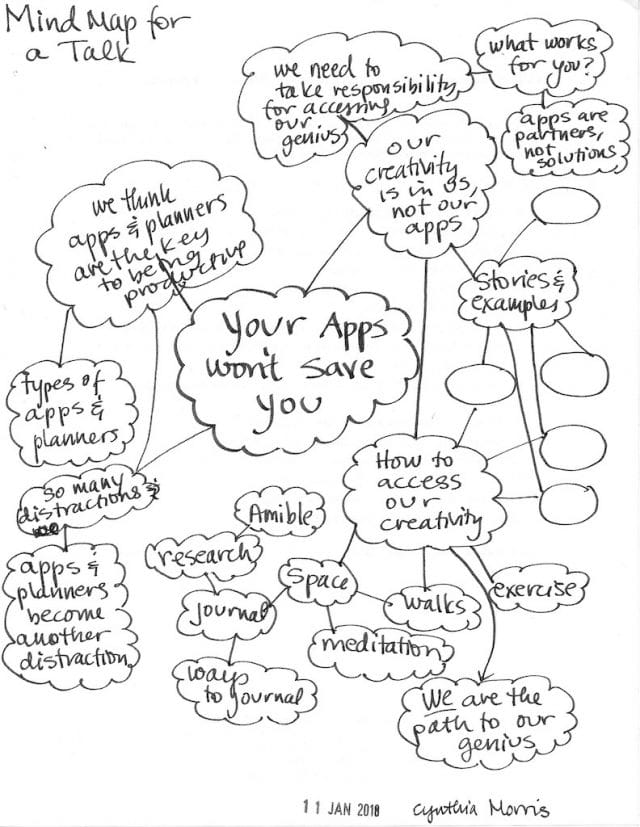
Here’s a mind map here of a talk I developed. I brainstormed the premise and ideas around this topic. You can see it’s messy, but that’s okay. The content is out of my head and onto paper and I can start writing, using each bubble as a prompt to get started.

Four ways to mind map

Try it for yourself, using mind mapping to generate a list of prompts. Here are a couple ways to experiment with that.

Method one: Simple piece of paper or notebook.

Method two: Gather sticky notes and a blank wall or large piece of paper.

Method three: Use index cards.  You may use several different colors, in order to color code different types of content that are in your book. Red for explication, green for example stories, yellow for exercises.

Method four: Use a digital mind mapping program like Milanote (which allows for exportable PDFS, unlike other programs, Simple Mind or Mindmeister.

Instructions for mind mapping your book’s topic on paper

I don’t use a mind mapping app because it’s just so fun and easy to use an analog process. I prefer the spaciousness that I feel when I am not looking at a screen.

Here’s my go-to method for developing writing prompts for my book using a paper mind map. 

Get a piece of paper. You can get a large one or just a piece of printing paper. In the center of a page, put the basic premise of your book in large letters. It’s helpful if you have a working title, but don’t fret if you don’t. If you are using sticky notes or cards, simply lay them out as you write ideas on each piece.

Now, brainstorm different things you want to say. There may be several large categories, each having its own bubble that comes off the central bubble.

For each category, capture the ideas you have for that category. Each idea has its own bubble, sticky note or index card. Don’t worry too much about organizing your ideas now; just get as many of them out as you can.

You can see from my mind map that the content isn’t completely organized. That’s okay. The organizing will come later, after I’ve drafted most of the pieces.

From here, I often move each item to an index card. This creates a deck of writing prompts that I can use to write from. The index card/sticky note process allows you to move your ideas around if you find they belong with a different category than you originally thought.

Keep playing with this until you are out of ideas. Go take a break and come back to see it anew. The mind map can be a living document that grows over time.

Inquiries for greater understanding:

  • What do you notice about your content?
  • Which categories have the most ideas?
  • Which ideas or categories feel most compelling to you?

Let this settle for a week or so, adding to it and moving things around until you feel you have most of your ideas on paper and where you want them to be.

Use mind mapping to get your ideas on one topic onto the page. This is a fun and non-linear way to gather your thoughts.

Final thoughts on mind mapping your book ideas

Write from each prompt until you’ve exhausted your ideas. This may take several writing sessions before you feel complete with the prompt. 

Remember that writing from these prompts is simply drafting or capturing your ideas. The writing will be rough, messy, and unorganized. It will feel incomplete and perhaps incoherent. Don’t fret! This writing will also be raw, real and fresh. It will have your voice and your conviction on it. It will be material that you will revise, edit and sculpt into something you can share with the world. But don’t get ahead of yourself with word smithing and perfectionism, either in developing your prompts or free-writing from them. 

Writing prompts can be simple. Don’t overthink them. The best part of free-writing is the surprises that emerge when you step aside and let your pen lead the way. Writing prompts can help you dive in and swim past the inner critic to write anything, anytime. 

To recap:

  1. Map your ideas on paper.
  2. Take the most juicy ideas and put them into a list or on index cards to use as prompts.
  3. Mind map each idea until you know what you want to say.
  4. Use each idea or bubble as a free-write prompt to get your thoughts onto the page.

What will you mind map now?

Filed Under: Creativity, The Writing Life Tagged With: mindmap

June 9, 2020 by Cynthia Morris 1 Comment

Writing as a power tool to end systemic racism

The protests of the horrible death of George Floyd and other black people in the US have finally brought our systemic racism to the surface in a way no one can ignore. I feel my own complacency has reached its expiration date.

It’s hard to see violence ripple through the world like this. And I know that massive change is often required to make the changes we need. Inertia, as you may well know, is a powerful force.

There is a feeling of hope that this time, finally, we are awake to the fact that the world needs to change. Is changing. If our constitution promises liberty and justice for all, that has to be more than lip service. This is going to take some work and each of us plays a part.

I don’t have answers for what you should do to end racism now. I know what I am doing. I’m taking a tip from my friend Jonathan Fields. He suggested that the anti-racism work we need to do is a practice. It’s not a donate once and done kind of situation. It’s ongoing work on ourselves and work in the world.

How? Let’s figure it out. Don’t ever let not knowing how to do something keep you from doing something.

Writing as a power tool

As your writing coach, I encourage you to use writing in every instance. Writing clarifies. Writing heals. Writing shows us a path forward.

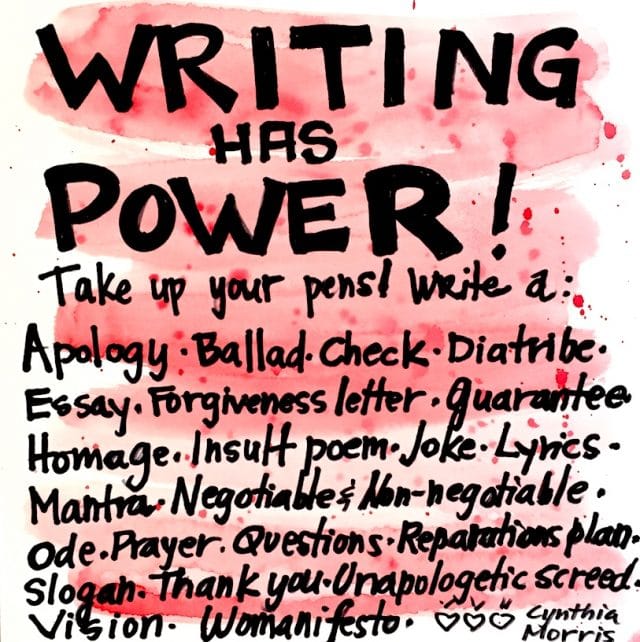
There are as many ways to use our words in this fight as there are words. Write a letter. Write a truth. Write an article. Write a confession. Write an apology. Write a commitment. Write a manifesto for a new world. Write a rant. Write a love letter.

writing has power to help be antiracist
Perhaps start with a free-write to get grounded and to get clear. Here are some bonus prompts I shared in The Devoted Writer salon this week:

  • Becoming an activist
  • How I lead
  • How I follow
  • My racism
  • Change and me
  • My addictions
  • Here’s what I want for the world
  • What I need now
  • My commitment to change

In my classes, we have talked many times about our emotions and how they impact our ability to write. I know many of us are having a hard time focusing on anything now. Hard to stop reeling and feeling and settle into any writing. That’s okay. Do what it takes to take care of yourselves. Do what you need for your writing. And do what we all need to make our world whole – do something to end racism.

I stand for peace and justice for all. I stand with Black Lives Matter and I commit to doing my part to end systemic racism in the US.

Do what is right for you, and if you feel like sharing the actions you are taking now, please do so in a comment below. I know that would inspire me and help me take more action.

Filed Under: The Writing Life

  • « Go to Previous Page
  • Page 1
  • Page 2
  • Page 3
  • Page 4
  • Page 5
  • Interim pages omitted …
  • Page 14
  • Go to Next Page »

Primary Sidebar

An Illustrated Feast

An Illustrated Feast watercolor workshop Paris Cynthia Morris
Cynthia Morris novel Her Lisbon Colors

Creative Success Stories

"Being coached by Cynthia highlighted my unrevealed gifts. Our time together has revolutionized the way I work and lead my companies.

Her wisdom about creativity and productivity has added value to every area of my life from personal health to creativity and generating wealth.

I would have never imagined that this powerhouse of a creative would help me grow, connect to my heart and improve my companies in so many areas. Cynthia’s coaching is like supercharging a normal engine; there is no comparison."

John Marsh
Founder, Marsh Collective

"For years, I struggled with this belief that I wasn't good enough, that I wasn't a real writer, that I wouldn't be able to follow through. Your coaching and support opened something in me that had gone dormant.

With your words in my ears and my heart finding new excitement, I pushed the words across the page. My first novel is complete. You, dear Cynthia, helped me lay the dominoes. I can’t thank you enough for the motivation, the inspiration, and the reminder that I was meant to write."

Tabetha Hedrick
Author

"Cynthia has given me my writing voice. I can now say I am a writer. My newsletter readers tell me how much they love receiving it!

Cynthia has a great spark of life that just shines out. She engages in a way that encourages you to challenge yourself as a writer and is there to help pull you out if you get stuck or lost."

Ruth Dent
Artist

"Cynthia helped me drive a short story across the finish line. I recommend Cynthia if you want to learn about your own writing process in an experiential way and get practice on things like letting go of perfectionism for a greater goal."

Roseanne
Writer

"Cynthia helped me so much to develop a writing practice. I love her approach to combining creativity and action. It's gentle and effective and highly self compassionate."

Laila Atalah
Writer

"Because of my work with Cynthia, I have been able to embrace my artist's path and choose a lifestyle that truly speaks to my soul. Instead of trying to be and do everything, I now follow my true desires with courage, joy and serenity.

Cynthia is intuitive, down-to-earth, straightforward and honest. She can read between the lines, and she never lets me run away, give in and give up. Cynthia is a fabulous mentor and an amazing artist."

Maya Sofia Preston
Photographer

Let’s Connect

  • Email
  • Instagram
  • LinkedIn
  • YouTube
Finally be the creator you came here to be
  • This field is for validation purposes and should be left unchanged.

Copyright © 2026 Original Impulse. All Rights Reserved. Privacy Policies.