
I love the question I’m asking today. It’s one of those that’s impossible to answer.
I ask it because I always want my clients to feel and appreciate the impact writing has on their days.
At the end of my Impulse Writing Club sessions, I invite writers to jot three words that describe their state of being. We do this at the beginning, too, to see a contrast between before and after writing.
Atelier
This notion of who you would be if you didn’t write is really at the core of why I help people bring their ideas into form. I think the projects we harbor but don’t do have a negative impact on us.
What if this were the time for you to focus on your project? Perhaps all you need is a supportive container to keep you on track.
Applications are coming in for the Atelier. This eight-month program gives you all the insight you need about your process so you can keep going with your project. Find out how you can be part of it here.
Writing to Heal
 I have been writing steadily since 1994. I’ve written poetry, plays, dramatic monologues, a novel, non-fiction books, short stories, video and podcast scripts, and articles about the creative process.
Can you even imagine who I would be if I did not have this inky channel to get my thoughts and feelings out onto the page?
I imagine a dark, crowded, cluttered garage full of unprocessed ‘stuff’ and unacknowledged ideas. I imagine I would be a very cranky, mentally and emotionally constipated person.
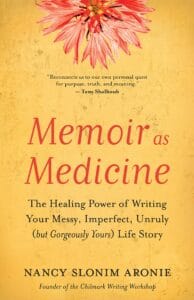
So of course I loved Nancy Slonim Aronie’s book Memoir as Medicine. I work with a lot of people who are writing pieces of their life story.
Most people want to get their experiences onto the page to help others. But in the process of writing their stories, they are transformed. Nancie’s book offers a great range of short, poignant exercises to help us come to the page with new eyes and fresh angles.
If you have been wanting to write your stories down to get them out and unclutter your inner landscape, Nancie’s book is a great resource.
You don’t have to want to write a whole memoir or book to use this helpful book full of prompts.
If you want to write, please do it. Make it easy on yourself to pick up a pen and ink your ideas.
Meanwhile, share your thoughts in the comments below.
That’s exactly how I started writing – what you described about Nancy Aronie’s experience. It started out as a promise to journal daily for one year, inspired by a class I took from Marie Cartier at the Arvada Center (actually 3 classes). I set up my room and everything I needed, and the date – January 1, 1992. And I was fully into the practice very quickly. I was writing things I never expected to come up, and getting up (no alarm) at 4:30 am every morning to do it! It floored me. By the time I was close to the end of one year, I described a “dark thing” pressing on my brain. Turns out the next month they were repressed childhood memories that did explode at the end of that first year. To say it was unsettling is so far from the right word for it – it was life-changing, literally. I kept writing. Than later on, by a few years, I chose a graduate program because I could choose a “creative project” instead of a thesis (Humanities, at UCD). I wrote a memoir composed of prose and poetry pieces I had written over the years – got an A from my committee, who swore they “loved” it. I tried (not very hard) to get it published. It’s a multi-genre work that is more art than literature, taking a peek inside my brain at work. From then on, I promoted journaling as a way to heal. It worked for m.
Wow, Dana, I love this story of your writer’s genesis. It’s amazing how the process of free-writing or journaling can open up things we didn’t know we needed to express.
Thirty years later, you are still writing. That’s impressive and I am so glad you have this modality of expression and healing. That’s true medicine.